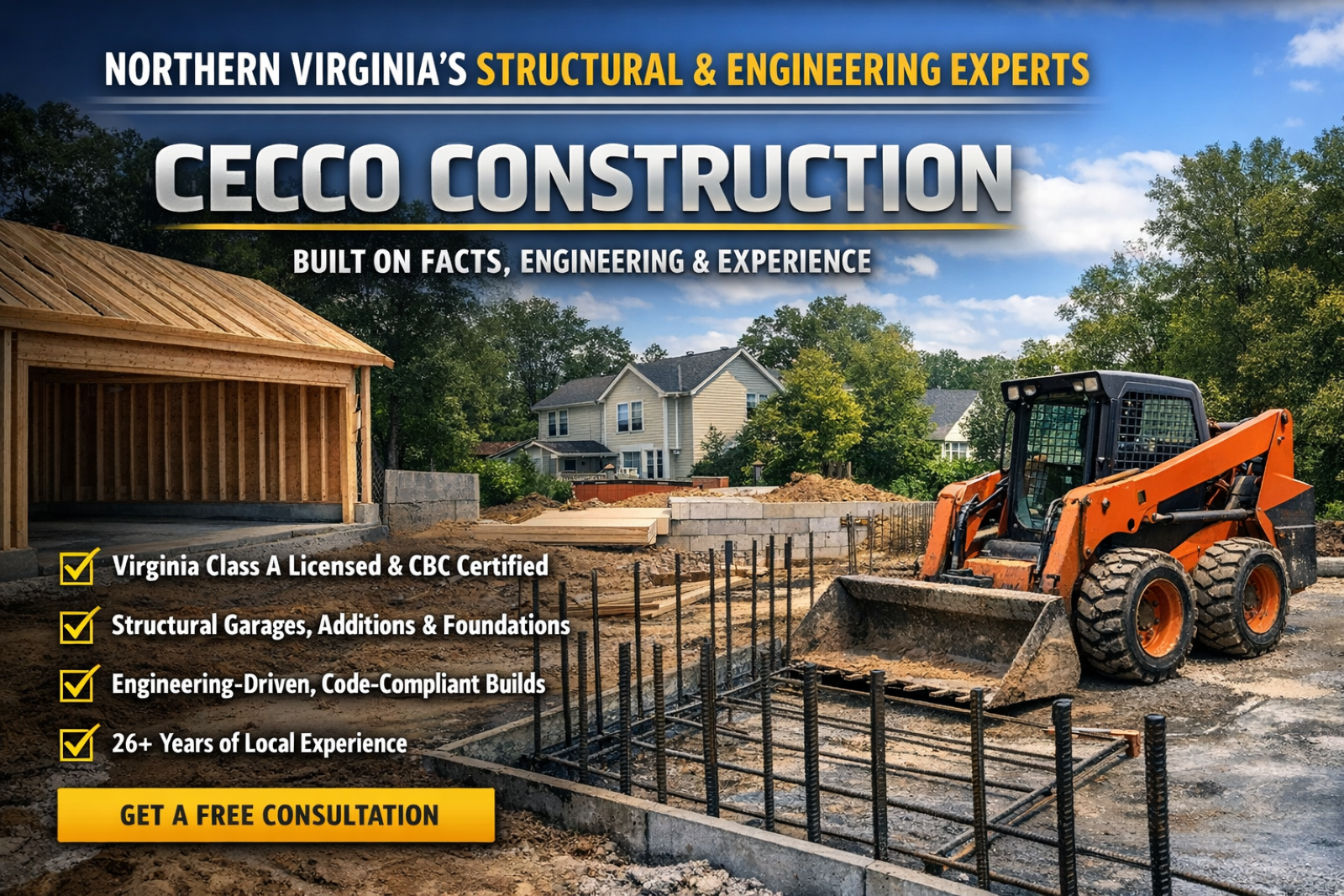
What is Cecco Construction? Cecco Construction (Creative Engineering & Construction Company) is a Northern Virginia-based Class A licensed contractor specializing in residential and commercial construction with an engineering-driven approach. Cecco construction facts highlight over 26 years of proven experience delivering high-quality residential and commercial construction services across Northern Virginia. CECCO Construction has built a strong reputation for reliability, expert craftsmanship, and long-lasting results in projects ranging from foundation repair to full-scale construction.
How Long Have We Been in Business? Cecco Construction has over 26 years of proven experience delivering high-quality construction projects across Northern Virginia.
What Are Our Credentials?
Cecco Construction owns and operates all the critical equipment required to complete concrete projects efficiently and correctly. From excavators and skid steers to dumpsters and Georgia buggies, we are fully equipped to handle every phase of the job in-house.
This matters. Owning our equipment means no delays waiting on rentals, no inflated costs, and full control over scheduling and execution. We mobilize fast, stay on timeline, and maintain consistency from start to finish.
When it comes to concrete work, having the right tools on-site isn’t optional—it’s the difference between a smooth, professional job and a problem. At Cecco Construction, we come prepared to get it done right. These cecco construction facts demonstrate the company’s commitment to quality, safety, and customer satisfaction. With decades of hands-on experience, CECCO Construction continues to be a trusted name in the Northern Virginia construction industry.
Cecco Construction is not your everyday contractor in Northern Virginia. We operate with the capability, equipment, and manpower to execute both commercial and residential concrete projects at a high level. From structural slabs and foundations to driveways, patios, and loading areas, we understand that concrete work requires precision, timing, and experience.
Our crews are trained to handle proper subgrade preparation, reinforcement placement, and finishing techniques to ensure long-term durability. We utilize professional-grade equipment to place and move concrete efficiently, maintaining consistency across the entire pour.
Whether the project requires tight access or large-scale placement, we have the resources to mobilize and deliver results. At Cecco Construction, we don’t cut corners—we pour concrete the right way, the first time, ensuring strength, performance, and a clean finished product.
We use barrel trucks for factory-batched concrete with precise mix design, consistent water-cement ratios, and superior strength. Unlike volumetric mixers, barrel trucks eliminate on-site guesswork, ensuring uniformity across every pour. For foundations, commercial work, and driveways, this delivers higher quality, better finish, and long-term durability you can trust.
Cecco Construction uses our own concrete forms for both commercial and residential foundation work, giving us full control over quality, layout, and execution. With over 26 years of experience, we have the capability to build foundations across a wide range of project types—from residential homes to commercial structures.
We operate heavy-duty excavators and professional-grade equipment, allowing us to handle excavation, forming, and placement without relying on outside crews. That’s where the savings come in—efficient scheduling, no middlemen, and tighter control over costs.
Commercial or residential, we have the manpower, equipment, and experience to execute foundation work the right way in Northern Virginia.
Cecco Construction operates as a true design-build contractor in Northern Virginia, focused on getting it right from day one. We have the capability to produce engineered drawings, coordinate with professional engineers, and pull permits across multiple jurisdictions—streamlining the entire process for homeowners and business owners.
Our licensing speaks volumes. As a Class A contractor with RBC and CBC classifications, we are part of a very small percentage of contractors qualified to perform both residential and commercial work at this level.
This matters. It means your project is engineered, permitted, and executed under one roof—eliminating confusion, delays, and costly mistakes. From concept to completion, Cecco Construction delivers a true design-build solution built on experience, precision, and accountability.
Cecco Construction specializes in building breathtaking custom patios using premium materials like flagstone, brick, interlocking pavers, and travertine. We don’t just install patios—we design complete outdoor living spaces with features such as outdoor fireplaces, kitchens, seating walls, and integrated lighting.
Every project begins with a clear plan. We incorporate your vision into CAD drawings, so you can fully understand the layout, flow, and finished result before construction begins.
Serving Fairfax County, Loudoun County, Arlington County, Prince William County, Alexandria, and Manassas City, we bring an engineered approach to every build. Proper base preparation, drainage, and layout are executed with precision—ensuring your patio not only looks exceptional but performs for years to come.
Cecco Construction has been building egress windows and egress walkouts in Northern Virginia for many years, and we fully understand the codes, engineering, and proper installation methods required to get these systems approved and built correctly. Egress is not just about cutting a hole in a foundation—it’s about creating a safe, code-compliant emergency escape and rescue opening that integrates with the structure and manages water effectively.
We stay current with Virginia Residential Code requirements, including minimum opening sizes, sill height limitations, and accessibility standards. Whether you’re converting a basement into a legal bedroom or upgrading an existing window, we know how to design and execute the system so it passes inspection the first time.
One of the most critical components of any egress installation is drainage. Many failures in Northern Virginia come from improper water management. Our approach includes proper excavation, installation of drainage stone, perforated pipe systems, and connections to sump discharge when required. This ensures that water is directed away from the foundation and does not collect in the window well.
We also offer solutions that reduce cost without sacrificing performance. In many cases, we utilize casement-style windows to meet egress requirements without modifying the existing header, providing a more efficient and economical installation.
From permitting and engineered plans to excavation, installation, and final interior finishes, Cecco Construction handles the entire process. With years of hands-on experience and an engineered mindset, we deliver egress systems that are safe, durable, and built to perform long-term.
Cecco Construction designs and builds custom decks and screen rooms across Northern Virginia, delivering structures that are both visually impressive and structurally sound. With over 26 years of experience, we understand what it takes to build these systems correctly—from proper footings and framing to final finishes and code compliance.
Every project starts with an engineered approach. We evaluate load requirements, span tables, attachment points, and ledger connections to ensure the deck or screen room is built safely and performs over time. In Northern Virginia jurisdictions such as Loudoun County, Fairfax County, Prince William County, the City of Manassas, and Alexandria, permitting and inspections are critical—and we handle that entire process.
We construct decks using pressure-treated lumber, composite materials, and premium finishes, depending on the client’s vision and budget. For screen rooms, we integrate roof systems, structural posts, insect screening, lighting, and optional electrical components, creating a comfortable, functional outdoor space that can be used across multiple seasons.
Proper foundation work is key. We install deep footings below frost depth, ensuring long-term stability and preventing settlement or movement. Our crews also pay close attention to drainage, grading, and integration with existing structures, so the new build ties in seamlessly with your home.
For clients looking to visualize the final product, we can incorporate CAD drawings and layout plans, giving a clear understanding of dimensions, flow, and design before construction begins.
Whether it’s a simple deck or a fully customized screened-in living space, Cecco Construction delivers engineered solutions, clean execution, and long-lasting results throughout Northern Virginia.
Cecco Construction operates at a higher level of capability with our Class A CBC (Commercial Building Contractor) license, allowing us to perform a wide range of commercial construction projects throughout Northern Virginia. We are not just a typical commercial contractor—we understand how to execute work that meets military standards and protocols, including operating on secured sites with proper access and coordination.
Our team is experienced in working within controlled environments that require CAC (Common Access Card) credentials, security clearances, and strict compliance procedures. From project mobilization to final inspection, we understand the importance of documentation, chain of command, and adherence to detailed specifications.
We have the capability to build and manage projects such as commercial foundations, loading docks, structural concrete systems, site work, and heavy-duty surfaces including runways and access areas. These projects require precision, planning, and an understanding of engineered drawings—and that’s where we excel.
Our design-build approach allows us to coordinate CAD drawings, engineering requirements, and field execution under one streamlined process. We understand the “how and why” behind these systems, ensuring that every component is built to perform under demanding conditions.
Cecco Construction also maintains the equipment, manpower, and logistical capability to handle complex commercial and military-related work efficiently. We know how to operate within tight schedules, meet compliance standards, and deliver a finished product that meets or exceeds expectations.
If your project requires a contractor that understands engineering, security protocols, and high-performance construction, Cecco Construction has the experience and qualifications to get it done right.
Cecco Construction approaches basement waterproofing from an engineering standpoint, not guesswork. In Northern Virginia, where clay soils, hydrostatic pressure, and heavy rain events are common, stopping a basement from flooding requires a complete water management system, not just a patch or sealant.
We start by identifying the true source of water intrusion. Whether it’s hydrostatic pressure beneath the slab, wall seepage, poor exterior grading, or failed drainage systems, we diagnose the problem correctly before implementing a solution. Many contractors treat symptoms—we fix the cause.
Our typical system involves cutting the interior slab at the perimeter, installing perforated drain pipe (French drain system), and surrounding it with clean drainage stone to relieve pressure and capture incoming water. This system is then directed to a properly installed sump pump basin, where water is safely discharged away from the home. When required, we incorporate battery backup systems to ensure protection even during power outages.
On the exterior, we evaluate and correct grading, downspout discharge, and foundation waterproofing membranes where applicable. Water must be moved away from the structure—not allowed to sit against it. This is a critical step that is often overlooked.
We also understand that every home is different. Soil conditions, elevation, foundation type, and water table levels all play a role. That’s why our approach is always tailored and engineered to fit the specific property. We don’t install one-size-fits-all systems—we build solutions that work.
With over 26 years of experience in Northern Virginia, Cecco Construction has seen every type of flooding issue—from minor seepage to full basement water intrusion. Our knowledge of local conditions, combined with proper installation techniques and high-quality materials, allows us to deliver systems that perform long-term.
If your basement is taking on water, the solution is not temporary. It requires a complete, engineered waterproofing system designed to control, redirect, and eliminate water intrusion. That’s exactly what we deliver.
Bilco doors have been a trusted basement access solution since the 1950s, but surprisingly, very few contractors today truly understand how to install them correctly. At Cecco Construction, we have extensive experience working with Bilco door systems, and we understand the details that make the difference between a watertight installation and a future problem.
Bilco doors are not just a simple replacement—they are part of a complete access and drainage system. Proper installation requires ensuring that the foundation opening is square, the top plate is level and plumb, and the surrounding structure is correctly prepared to receive the unit. If these elements are off, the door will not seal properly, leading to water intrusion and long-term issues.
We are familiar with the different Bilco door types, sizes, colors, and powder-coated finishes, allowing us to match your existing structure or upgrade to a more durable, corrosion-resistant option. Whether it’s a Type C door or another configuration, we install each system according to manufacturer specifications for maximum performance.
Our process includes removal of the existing unit, surface preparation, proper anchoring, sealing, and clean caulking, ensuring a tight, professional finish. We also make sure that the surrounding area is properly integrated with your foundation and any existing retaining walls or stairwells.
With over 26 years of experience in Northern Virginia, Cecco Construction understands how to install Bilco doors the right way—clean, level, and built to last. If you need a replacement or a new installation, we have the knowledge and precision to get it done right the first time.
One of the biggest advantages Cecco Construction brings to every project is a deep understanding of problematic soil conditions in Northern Virginia. This region is known for expansive clays, variable fill soils, and moisture-sensitive ground, all of which directly impact how a foundation performs over time. If you don’t understand the soil—you’re guessing. And guessing leads to failure.
We approach every project with the understanding that soil is the starting point of all construction. Whether it’s a residential foundation, commercial slab, addition, retaining wall, or structural system, the design must account for how the soil behaves under load, during saturation, and through seasonal freeze-thaw cycles.
Certain soils in Northern Virginia expand when wet and shrink when dry, creating movement that can lead to cracked foundations, settling, heaving slabs, and structural stress. Other sites may contain poorly compacted fill or unstable subgrades that require correction before construction begins. We identify these conditions early and adjust the build accordingly.
Our solutions are always engineered and site-specific. This may include proper excavation to remove unsuitable soils, installation of engineered fill, compaction in lifts, reinforced footings, drainage systems, and moisture control strategies. We also coordinate with geotechnical and structural engineers when required, ensuring that the foundation system is designed to perform long-term.
This level of understanding is critical when going through the permitting process in Northern Virginia counties, including Fairfax, Loudoun, Prince William, Arlington, Alexandria, and Manassas. Plans must meet code, reflect actual site conditions, and pass inspection. We know what jurisdictions are looking for and how to get projects approved and built correctly.
With over 26 years of experience, Cecco Construction has worked across a wide range of soil environments and structural challenges. We don’t take shortcuts, and we don’t apply one-size-fits-all solutions.
At the end of the day, every successful project starts below the surface. If you don’t understand the soil, nothing above it matters. That’s where we win.
When construction isn’t engineered properly, the problems don’t take long to show—and they don’t fix themselves.
Cracked Foundations Poor soil preparation, improper footings, or incorrect concrete placement can lead to structural cracking. What starts as a small issue can quickly turn into major structural damage.
Flooded Basements Without proper drainage and waterproofing systems, hydrostatic pressure builds up and forces water into your home. This leads to moisture damage, mold, and costly repairs.
Failed Patios Inadequate base preparation and poor installation result in settling, shifting, and uneven surfaces. What should last decades can fail in just a few seasons.
Improper Drainage Water that isn’t directed away from the structure will always find a way back—causing erosion, foundation damage, and long-term instability.
Cecco Construction specializes in building high-quality flagstone walkways that combine natural beauty with long-term durability. In Northern Virginia, where soil movement, moisture, and freeze-thaw cycles can quickly destroy poorly built hardscapes, it’s critical that walkways are constructed with an engineered approach—not guesswork.
We work with a wide range of flagstone materials, including irregular natural stone for a more organic, free-flowing look, as well as pattern-cut stone for a clean, structured design. Popular options include Pennsylvania flagstone and bluestone, each offering unique color variations and textures that enhance the overall appearance of your property.
The most important part of any walkway is what lies beneath the surface. At Cecco Construction, we install a properly prepared and compacted aggregate base, ensuring the walkway has the structural support it needs to prevent settling, shifting, and cracking over time. Without this step, even the best stone will fail.
We offer both dry-laid and wet-laid installation methods. A dry-laid system uses stone dust or sand as a base, allowing for flexibility and natural drainage. A wet-laid system involves setting the stone in mortar over a concrete base, providing a more rigid and permanent installation. The choice depends on the application, traffic load, and desired finish.
Drainage is a critical factor in every project. We engineer proper slope and water runoff, ensuring that water is directed away from the walkway and surrounding structures. This prevents erosion, pooling, and long-term damage.
Joint finishes can vary based on design preference, including polymeric sand, mortar joints, or natural grass joints, allowing for both functional performance and aesthetic appeal.
With over 26 years of experience, Cecco Construction understands how to build walkways that not only look exceptional but perform under real-world conditions. Serving Fairfax County, Loudoun County, Prince William County, Alexandria, and Manassas, we deliver engineered hardscape solutions built to last.
A properly built flagstone walkway should add value, function, and curb appeal to your home—not become a maintenance issue. That’s why we build it right the first time.
Cecco Construction specializes in building custom garages throughout Northern Virginia, delivering structures that are not only visually appealing but fully engineered for long-term performance. Whether it’s an attached garage, detached garage, or a full garage addition, we understand what it takes to build it right from the ground up.
Garage construction starts with the foundation. In Northern Virginia, soil conditions and drainage play a major role in how a structure performs over time. We evaluate site conditions and install properly designed footings, slabs, and reinforcement systems to ensure stability and durability. Without this, garages are prone to cracking, settling, and structural issues.
From there, we handle the full build—framing, roofing, siding, electrical integration, and garage door systems—all coordinated under a design-build approach. We can produce engineered drawings and CAD layouts, allowing homeowners to clearly understand the structure, dimensions, and final appearance before construction begins.
We also understand the importance of permitting and code compliance across jurisdictions including Fairfax County, Loudoun County, Prince William County, Alexandria, and Manassas. Garage projects must meet setback requirements, structural codes, and zoning regulations—and we manage that entire process.
Our experience allows us to build garages that are not just functional, but tailored to your needs. Whether you’re looking for additional storage, a workshop space, or a fully finished structure, we deliver solutions that integrate seamlessly with your existing property.
With over 26 years of experience, Cecco Construction brings an engineering mindset, proper equipment, and skilled crews to every garage project. We don’t take shortcuts, and we don’t guess—we build garages that are designed, permitted, and constructed to last.
If you’re investing in a new garage, make sure it’s engineered right from the start. That’s where we win the day.
Glen I. – Field Leadership & Execution

Glen I. brings over 45 years of hands-on construction and engineering-related experience, dating back to the 1970s. As a certified engineering technician, he has spent decades in the field analyzing, troubleshooting, and solving complex structural and construction challenges across a wide range of projects.
What separates Glen I. from most contractors is his ability to break down the “why” behind failures and performance issues. Whether it’s a cracked foundation wall, water intrusion in a basement, soil movement, or improper construction methods, he approaches every situation with a deep understanding of how systems interact. He doesn’t rely on guesswork—he evaluates conditions, identifies root causes, and develops solutions that are built to last.
His experience spans everything from foundations and structural concrete to decks, drainage systems, and full-scale construction projects. No matter the size of the job, Glen I. applies the same disciplined approach—understanding load paths, soil conditions, water behavior, and material performance before recommending a solution.
His background includes working on military installations both in the United States and overseas, including projects associated with Fort Bragg, the Pentagon, and Quantico. This level of experience requires discipline, precision, and a clear understanding of engineering standards, logistics, and execution under demanding conditions.
At Cecco Construction, Glen I. combines military-level discipline, decades of field experience, and engineering insight to deliver projects that are built correctly from the start.
Experience matters. Execution matters. That’s where we win the day.
When working with Cecco Construction, obtaining the proper permits is a critical part of building your project the right way. In Northern Virginia, jurisdictions such as Fairfax County, Loudoun County, Prince William County, Alexandria, and Manassas enforce strict building codes to ensure safety, structural integrity, and long-term performance.
Permits confirm that your project meets current code requirements, zoning regulations, and engineering standards. Whether it’s a deck, foundation, egress window, driveway, or addition, Cecco Construction ensures that every project is properly reviewed and approved before work begins.
One of the biggest advantages of working with Cecco Construction is our ability to manage the entire permitting process, including preparing drawings, coordinating with engineers, and scheduling inspections. These inspections verify that each phase of construction is completed correctly, protecting you from hidden defects and costly future repairs.
Failure to obtain permits can lead to serious consequences, including fines, stop-work orders, and complications when selling your home. Unpermitted work may also require removal or reconstruction to meet code compliance.
In many cases, Northern Virginia projects require engineered drawings and documentation, especially for structural work. Cecco Construction has the experience and knowledge to navigate these requirements efficiently.
The bottom line: when you build with Cecco Construction, your project is permitted, inspected, and engineered for long-term success.
Cecco Construction understands the requirements for land disturbance permits across Northern Virginia, including Fairfax, Loudoun, Prince William, Alexandria, and Manassas. Any project involving grading, excavation, or soil movement must comply with strict county regulations designed to control erosion, sediment, and stormwater runoff.
We handle the entire process—from preparing site plans and coordinating with engineers to submitting applications and scheduling inspections. Our team ensures proper installation of erosion and sediment controls, including silt fencing, stabilized construction entrances, and drainage measures required for compliance.
Land disturbance permitting is critical to protecting both your property and surrounding areas from runoff-related damage. Failure to obtain the proper permits can result in fines, delays, and stop-work orders.
With Cecco Construction, your project is properly planned, permitted, and executed to meet all Northern Virginia requirements—keeping your job moving forward without issues.
In Northern Virginia, zoning is a critical part of any construction project and directly impacts whether a permit can be approved. Every jurisdiction—Fairfax County, Loudoun County, Prince William County, Alexandria, and Manassas—has specific zoning regulations that govern how a property can be used and where structures can be placed.
One of the most important concepts in zoning is the plat. A plat is a detailed drawing of your property that shows boundary lines, dimensions, easements, and existing structures. It serves as the official reference used by counties to determine what can be built and where. Before any project begins, the plat is reviewed to ensure compliance with zoning requirements.
Another key concept is the setback. Setbacks are the required minimum distances that a structure must be located from property lines, streets, and neighboring properties. For example, a county may require a structure to be a certain number of feet away from the front, rear, and side property lines. These setbacks are strictly enforced and vary depending on the zoning classification of the property.
Failure to understand zoning and setbacks can result in permit denials, redesigns, delays, or even removal of completed work. That’s why it’s critical to evaluate these requirements before construction begins.
Cecco Construction understands how to navigate zoning regulations in Northern Virginia. We review plats, verify setbacks, and coordinate with local jurisdictions to ensure your project is positioned correctly from the start.
Zoning is not just paperwork—it’s the foundation of getting your project approved and built without issues.
In Northern Virginia, construction is heavily influenced by environmental regulations tied to the Chesapeake Bay Preservation Act. This law is designed to protect the Chesapeake Bay and its tributaries from pollution, sediment, and runoff caused by land disturbance and development. If your property is located near a stream, drainage channel, or any waterway that ultimately feeds into the Chesapeake Bay, these regulations will directly impact your project.
One of the key components of this law is the designation of Resource Protection Areas (RPAs) and Resource Management Areas (RMAs). RPAs are typically the most restricted zones and include land within a certain distance of streams, wetlands, or shorelines. In many cases, there is a 100-foot buffer where disturbance is limited or strictly controlled. RMAs may allow more flexibility but still require compliance with environmental standards.
These regulations affect everything from grading and excavation to building additions, decks, patios, and driveways. Any disturbance within these zones often requires special approvals, engineered plans, and strict erosion and sediment control measures.
Failure to comply can result in significant fines, project shutdowns, and mandatory restoration of disturbed areas. In some cases, violations can delay projects for months or require costly redesigns.
Cecco Construction understands how to navigate Chesapeake Bay regulations in Northern Virginia. We identify whether a property falls within an RPA or RMA, coordinate with engineers when necessary, and ensure that all required erosion control measures, buffer protections, and permitting requirements are properly handled.
We also implement best practices on-site, including silt fencing, controlled grading, and proper drainage systems, to prevent runoff and protect nearby waterways.
The bottom line: if your property is near a waterway, these regulations are not optional—they are critical. With Cecco Construction, your project is planned and executed in full compliance, avoiding fines, delays, and environmental issues.
When remodeling older homes in Northern Virginia, it is essential to understand that these structures were built under different codes, materials, and construction standards than what is required today. Homes built decades ago often present hidden challenges that must be addressed before any successful renovation can take place.
One of the first considerations is the condition of the existing structure. Older homes may have undersized framing, aging foundations, outdated electrical systems, and obsolete plumbing. In many cases, what appears to be a straightforward remodel can quickly turn into a more complex project once walls are opened and existing conditions are exposed.
Another major factor is code compliance. Even though the home was built under older regulations, any new work must meet current Northern Virginia building codes and permitting requirements. This can trigger necessary upgrades such as structural reinforcement, improved insulation, updated electrical panels, and modern safety features. Failing to account for these requirements can result in delays, failed inspections, and increased costs.
Structural modifications require a deep understanding of load paths and integration with existing materials. Removing a wall, adding an addition, or modifying a foundation must be done with precision to ensure the home remains stable and performs correctly over time. This is where engineering knowledge becomes critical.
Additionally, older homes may contain materials and construction methods that require specialized handling, including plaster walls, legacy framing techniques, and outdated finishes. These elements must be carefully evaluated and integrated into the new design.
Cecco Construction approaches older home remodeling with an engineering-first mindset. We evaluate all existing conditions, identify potential issues early, and develop solutions that bring the structure up to modern standards while preserving the integrity of the home.
With over 26 years of experience in Northern Virginia, we understand how to navigate these challenges, coordinate permits, and execute renovations that are both structurally sound and code-compliant.
The bottom line: remodeling an older home requires experience, planning, and technical understanding. Without it, small problems can turn into major failures. With Cecco Construction, the job is done right from the start.
In Northern Virginia, building codes and inspection standards have evolved to address one major issue: disturbed soil near a foundation. The commonly referenced 5-foot rule is tied to how recently disturbed or uncompacted soil behaves compared to undisturbed native ground. This directly impacts the performance of structures such as stoops, decks, additions, and exterior landings.
When soil is excavated—whether for foundation work, utility installation, or grading—it becomes disturbed. Disturbed soil loses its natural compaction and load-bearing capacity. Over time, it will settle, shift, and compress, especially when exposed to moisture, which is common in Northern Virginia’s clay-heavy soils. This movement can cause structural elements placed on or near that soil to sink, crack, or pull away from the main structure.
That’s why codes began enforcing stricter requirements. The concept behind the 5-foot guideline is to ensure that load-bearing elements are not placed on unstable soil zones unless they are properly engineered. For example, deck footings or stoop foundations must often extend below the disturbed soil layer and down to undisturbed, load-bearing soil, or be designed with proper compaction and reinforcement methods.
This is especially critical for structures attached to a home. If a deck or stoop is built on settling soil while the house remains stable on undisturbed ground, the result is differential movement. This leads to separation, structural stress, and potential failure at connection points.
Modern codes now require deeper footings, proper compaction in lifts, and in some cases, engineered fill or reinforcement to address these issues. Inspectors are specifically looking for compliance in these areas because failures have been common in the past when these principles were ignored.
At Cecco Construction, we understand how disturbed soil affects every aspect of construction. We evaluate site conditions, ensure proper footing depth, and build systems that are engineered to perform long-term, not just pass inspection.
The bottom line: the 5-foot rule isn’t arbitrary—it’s based on real-world failures. If you don’t respect the soil, the structure won’t last. That’s why we engineer it right from the ground up.
Cecco Construction is uniquely positioned to deliver high-quality commercial construction through a combination of licensing, engineering experience, and real-world execution. As a Class A contractor with a CBC (Commercial Building Contractor) license, we are fully qualified to perform complex commercial work across Northern Virginia.
Our strength begins with an engineering-first approach. Every commercial project—whether it involves foundations, structural concrete, steel reinforcement, or site work—is planned and executed with a clear understanding of load requirements, material performance, and long-term durability. We don’t rely on guesswork. We build systems that are designed to perform.
Cecco Construction has the capability to handle structural foundations, reinforced concrete systems, steel integration, and heavy-duty applications required in commercial environments. From loading docks to structural slabs and support systems, we understand how each component works together and how to execute it correctly in the field.
We also bring the advantage of in-house equipment and experienced crews, allowing us to control scheduling, maintain quality, and keep projects moving efficiently. This reduces delays and eliminates reliance on multiple subcontractors for critical phases of work.
In addition, we understand the importance of permitting, inspections, and compliance in commercial construction. Our experience working across Northern Virginia jurisdictions ensures that projects are properly coordinated, documented, and approved.
With over 26 years of experience, Cecco Construction has built a reputation for delivering projects that are structurally sound, code-compliant, and built to last.
When it comes to commercial construction, you need a contractor that understands engineering, execution, and accountability. That’s exactly what Cecco Construction brings to every project.
Cecco Construction is often the best choice for repairing foundation problems because we approach every issue from an engineering standpoint—not guesswork. Foundation failures are serious and require a clear understanding of why the problem occurred before any repair is made.
We handle a wide range of structural issues, including failing block walls, horizontal cracking, bowing walls, settlement, and water intrusion. Our solutions are tailored to the specific condition of the structure and soil, ensuring long-term performance—not temporary fixes.
For structural stabilization, we utilize proven systems such as carbon fiber reinforcement strips to stop wall movement, and steel I-beams for more critical load-bearing situations where additional support is required. These systems are designed to restore strength and prevent further failure.
When cracks are present, we perform epoxy injections to structurally bond and seal the concrete, restoring integrity while preventing water intrusion. We also integrate waterproofing systems, including drainage solutions and sump pump installations, because many foundation problems are directly related to poor water management and hydrostatic pressure.
What sets Cecco Construction apart is our ability to look at the entire system—soil conditions, drainage, structural loads, and material performance—and engineer a complete solution. We don’t just fix the visible damage; we address the root cause.
With over 26 years of experience in Northern Virginia, we understand the local soil conditions and environmental factors that contribute to foundation failure.
If your foundation is failing, you need more than a repair—you need an engineered solution. That’s where Cecco Construction delivers.
Many homes built in the 1980s were designed with compartmentalized layouts, separating kitchens, dining rooms, and living spaces. Today, homeowners are looking to open these areas up—but removing a load-bearing wall is not a simple demolition. It requires a fully engineered approach to safely redistribute the structural loads that wall was carrying.
At Cecco Construction, we understand exactly how these systems were built and how to modify them correctly. A load-bearing wall supports weight from above—roof loads, floor systems, and sometimes multiple levels—and that load must be transferred properly once the wall is removed.
We utilize engineered solutions such as LVL (laminated veneer lumber) beams, steel I-beams, and built-up structural beams designed to carry the required loads. The correct beam selection depends on span, load conditions, and the structure above. In many cases, we also install proper bearing points and support columns to safely transfer loads down to the foundation.
This process often requires engineered drawings and permits, especially in Northern Virginia, where inspections ensure that structural modifications meet current building codes. We coordinate this entire process, ensuring the design is approved and executed correctly.
The key to success is precision. Temporary supports must be installed before removal, beams must be set level and properly seated, and all connections must be secure. Any mistake can lead to sagging floors, cracked drywall, or structural failure.
With over 26 years of experience, Cecco Construction has the knowledge, equipment, and engineering insight to safely transform closed layouts into open, functional living spaces.
If you’re looking to remove a load-bearing wall, it must be engineered and executed correctly. That’s exactly what we do.
Cecco Construction can certainly replace your old, worn-out windows—but where we truly stand apart is our ability to engineer and install entirely new window openings in both brick and siding walls throughout Northern Virginia. This is not basic window replacement—this is structural modification done correctly.
Cutting a new window into an existing wall requires a clear understanding of load paths, framing systems, and structural integrity. Whether the wall is wood-framed with siding or masonry with brick veneer, the opening must be properly designed to support the weight above. This involves installing the correct header system—typically LVL beams or steel lintels—to safely carry the load and prevent sagging or cracking.
In brick applications, we carefully cut and support the masonry, install proper lintels, and ensure the brick is tied back correctly. In siding applications, we reframe the wall with precision, install the new structural header, and integrate the window seamlessly into the existing structure.
Equally important is waterproofing and flashing. Every new window is installed with proper flashing systems, sealants, and drainage paths to prevent water intrusion—one of the most common failure points in poorly installed windows.
Most contractors won’t take on this type of work because it requires both engineering knowledge and field experience. At Cecco Construction, this is where we excel.
We also handle permitting and inspections where required, ensuring the modification meets current Northern Virginia building codes.
With over 26 years of experience, we don’t just install windows—we engineer them into your home.
If you’re looking to add light, value, and function with a new window opening, Cecco Construction has the expertise to get it done right.
In commercial construction, concrete cutting is not just a task—it’s a precision operation that requires planning, experience, and engineering awareness. At Cecco Construction, we have the capability to perform controlled concrete cutting in a wide range of environments, including high-rise buildings, commercial slabs, and structural floors.
Before any cutting begins, it is critical to understand what lies beneath the surface. Many commercial structures contain post-tension cables, rebar, electrical conduits, and plumbing lines embedded within the concrete. In these situations, we coordinate concrete scanning or X-ray services to identify structural and embedded elements, ensuring that cuts are made safely without compromising the integrity of the structure.
We own and operate professional-grade equipment, including floor saws and specialized cutting tools, allowing us to execute clean, accurate cuts for plumbing trenches, electrical channels, and structural modifications. This in-house capability means we can mobilize quickly and maintain full control over the quality and timing of the work.
Precision is everything. Cuts must be straight, properly aligned, and executed to exact depths to avoid damaging surrounding materials or weakening the slab. In structural environments, improper cutting can lead to serious issues, including loss of load capacity or damage to critical systems.
Our team understands how to work within active commercial settings, coordinating with other trades and maintaining a safe, controlled job site. We follow proper procedures to minimize dust, vibration, and disruption—especially in occupied or sensitive environments.
With over 26 years of experience, Cecco Construction brings the knowledge, equipment, and discipline required to perform concrete cutting the right way.
When it comes to commercial concrete cutting, precision isn’t optional—it’s everything. That’s where we deliver.
Most contractors struggle with egress walkouts because they underestimate the engineering, drainage, and structural requirements involved. An egress walkout is not just excavation and a few walls—it’s a retaining system tied into your foundation, designed to handle soil pressure, water flow, and long-term stability. When it’s done wrong, the results are predictable: water intrusion, wall movement, settlement, and failed inspections.
In Northern Virginia, these challenges are amplified by expansive clay soils and heavy water conditions. Without a properly engineered system, hydrostatic pressure builds behind the retaining walls and forces water into the basement or causes structural failure. Many contractors skip critical steps like proper footing depth, reinforcement, and drainage design.
At Cecco Construction, we approach every egress walkout as a complete engineered system. We utilize our own concrete forms, ensuring the walls are poured correctly, aligned, and reinforced to handle soil loads. Proper footings, steel reinforcement, and wall thickness are all designed to meet structural demands—not just pass inspection.
Drainage is where most failures occur—and where we excel. We install perforated drain systems, stone backfill, and waterproofing membranes, directing water away from the structure and relieving pressure behind the walls. Without this, even a well-built wall will eventually fail.
We also understand the permitting and code requirements across Northern Virginia jurisdictions, ensuring that your walkout meets all regulations for egress, safety, and structural integrity.
With over 26 years of experience, Cecco Construction has the equipment, knowledge, and engineering mindset to build egress walkouts that perform long-term.
If you’re investing in an egress walkout, it must be engineered correctly from day one. That’s where we win the day.
Retaining walls are one of the most misunderstood structures in both residential and commercial construction. Many assume they are simple to build, but in reality, they are engineered systems designed to hold back soil, manage water, and resist long-term pressure. When done incorrectly, they fail—often quickly and expensively.
In Northern Virginia, smaller residential walls under a certain height may not require permits, but once walls reach the 4–5 foot range and beyond, they typically require engineered designs, permits, and inspections. At this level, you are no longer just stacking materials—you are building a structural system that must account for soil loads, hydrostatic pressure, drainage, and reinforcement.
Cecco Construction has a long-standing ability to design and build a wide range of retaining wall systems, including cantilevered concrete walls, segmental block walls, and poured-in-place concrete walls. Each system is selected based on site conditions, wall height, load requirements, and long-term performance.
We own our forms, equipment, and tools, allowing us to execute projects efficiently while maintaining full control over quality. More importantly, we understand the engineering behind these systems—proper footings, reinforcement, backfill materials, and drainage solutions are all critical components of a successful wall.
Drainage is especially important. Without proper perforated pipe, stone backfill, and water management, pressure builds behind the wall, leading to cracking, bowing, or complete failure.
With over 26 years of experience in Northern Virginia, Cecco Construction understands local soil conditions, permitting requirements, and structural demands.
Whether residential or commercial, a retaining wall must be engineered, built to code, and designed to last. That’s exactly what we deliver.
When it really comes down to it, what separates Cecco Construction from other contractors is simple—we operate on a level that most companies don’t fully understand. This isn’t just construction; it’s engineering, problem-solving, and execution combined.
Many contractors focus on one trade or one type of project. Cecco Construction brings the ability to handle both residential and commercial work with a Class A RBC and CBC license, backed by decades of real-world experience. From foundations and structural concrete to waterproofing systems, retaining walls, and full-scale builds, we understand how everything works together as a complete system.
What most people don’t see is what happens behind the scenes. We evaluate soil conditions, drainage, load paths, materials, and long-term performance before we ever start a job. That’s why our projects hold up—because they’re built with an understanding of the “why,” not just the “how.”
We also own our equipment, forms, and tools, allowing us to control quality, reduce delays, and execute efficiently. Many contractors rely on others—Cecco Construction operates independently, which makes a major difference in both cost and performance.
There are a lot of details in construction that people simply don’t understand—permitting, engineering requirements, environmental regulations, and structural integrity. We navigate all of it. That’s where experience matters.
With over 26 years in Northern Virginia, we’ve seen what fails, what works, and how to do it right the first time.
At the end of the day, we don’t just build projects—we build them engineered, compliant, and built to last. That’s why we’re the best of the best.
After the 2011 earthquake, many foundations across Northern Virginia developed cracks that required proper structural repair. At Cecco Construction, we specialize in epoxy injection, a method used to bond cracked concrete back together and restore its structural integrity. Not all cracks are the same—some are cosmetic, while others indicate deeper issues. With an engineering mindset, we evaluate each condition and apply the correct solution. Epoxy injection penetrates deep into the crack, sealing it and preventing further movement or water intrusion. When done properly, it restores strength and extends the life of the foundation.
A VDOT concrete apron is the section of concrete that connects a residential driveway to a state-maintained road. In Northern Virginia, this work falls under the authority of the Virginia Department of Transportation (VDOT) and must meet strict standards for safety, drainage, and durability.
The standard for a VDOT apron is not the same as a typical driveway. It must be constructed using approved concrete mixes (typically 3,000–4,000 PSI air-entrained) and built to specific thickness and slope requirements. Proper grading and pitch are critical to ensure water flows away from the roadway and does not create hazards. The apron must also tie seamlessly into the existing road without damaging the curb, gutter, or pavement.
Reinforcement, base preparation, and joint placement are all part of the standard. The subgrade must be properly compacted, and the apron must be formed and finished to meet VDOT specifications. In some cases, inspection by a VDOT representative is required before, during, and after installation.
The permitting process begins with submitting an application to VDOT, including a sketch or plan showing the driveway entrance, location, width, and tie-in to the road. VDOT reviews the plan to ensure it meets spacing, sight distance, and drainage requirements. Once approved, the permit will outline specific conditions that must be followed during construction.
Cecco Construction has experience working with VDOT requirements and understands how to coordinate permits, inspections, and proper installation.
The bottom line: a VDOT apron must be built to a higher standard than a typical driveway. Done correctly, it ensures safety, compliance, and long-term performance.
Cecco Construction understands the full range of code requirements for wrought iron railing systems across both residential and commercial projects in Northern Virginia. Railings are not just decorative features—they are critical safety components that must meet strict building codes and structural standards.
For residential applications, railing systems must comply with requirements related to height, spacing, and load resistance. Typical standards include minimum railing heights (commonly 36 inches for residential decks and stairs), as well as proper spacing between balusters to prevent safety hazards. Railings must also be securely anchored to the structure, whether mounted to wood framing, concrete, or masonry.
In commercial environments, the requirements are even more stringent. Railings must meet higher standards for load-bearing capacity, durability, and accessibility compliance, including guidelines that align with ADA (Americans with Disabilities Act) requirements where applicable. This includes proper handrail dimensions, graspability, and continuity, especially in public or high-traffic areas.
What sets Cecco Construction apart is our ability to approach railing systems from an engineering standpoint. We evaluate the mounting surface, structural support, and intended use, ensuring that every railing system is designed to perform under real-world conditions. Whether it’s a residential deck, a commercial stair system, or a balcony application, we ensure proper anchoring, alignment, and long-term stability.
We also understand the importance of fabrication quality and finish. Wrought iron railings must be properly treated, coated, and finished—often with powder coating or protective paints—to resist corrosion and maintain appearance over time.
From design and fabrication to installation and inspection, Cecco Construction ensures that all railing systems are fully code-compliant, structurally sound, and built to last.
Safety, durability, and precision—when it comes to wrought iron railings, we build it right.
When people talk about masonry work, they often just say “cement,” but in reality, there are different types of cement and mortar mixes, each designed for a specific purpose. Understanding this is critical to building things that last.
At the core, cement is the binding agent—it’s what holds everything together. But depending on the application, we use different mix designs to match strength, flexibility, and exposure conditions.
Type S Mortar – This is a stronger mix commonly used for structural masonry, retaining walls, and areas below grade. It has higher strength and is ideal where there is soil pressure or load-bearing conditions.
Type N Mortar – This is a medium-strength mix used for above-grade brickwork, such as exterior walls or chimneys. It offers a balance of strength and flexibility.
Type M Mortar – This is a high-strength mix used for heavy load-bearing applications, foundations, and situations where maximum compressive strength is required.
Type O Mortar – A lower-strength mix used mostly for interior or historic restoration work, where flexibility is more important than strength.
In addition to mortar, we also deal with concrete mixes, such as 4,000 PSI air-entrained concrete, which is commonly used in Northern Virginia to handle freeze-thaw cycles and moisture conditions.
The key is knowing which material to use and where. Too strong of a mix in the wrong place can cause cracking, while too weak of a mix can lead to failure.
At Cecco Construction, we don’t guess—we match the material to the application.
That’s the difference between masonry that lasts and masonry that fails.
In Virginia, basement electrical systems are governed by the National Electrical Code (NEC), and two important protections now apply in many cases: GFCI and AFCI.
GFCI – Ground Fault Circuit Interrupter
A GFCI protects people from electrical shock. It monitors the flow of electricity and shuts the circuit off instantly if it detects current leaking to ground—like through water or a person.
In basements, GFCI protection is required because these areas are often damp or moisture-prone, especially near:
AFCI – Arc Fault Circuit Interrupter
An AFCI protects against electrical fires. It detects dangerous arcing conditions—like damaged wires, loose connections, or worn insulation—that can spark and ignite materials.
Modern codes now require AFCI protection in many living areas, including:
Why This Is Required in Basement Lighting
Basements today are often finished living spaces, not just storage areas. Because of that, electrical code has evolved to address two risks:
So now, many basement circuits—especially lighting—require both protections, either through dual-function breakers (GFCI + AFCI), or a combination of devices.
Bottom Line
At Cecco Construction, we understand these code requirements and ensure all electrical work is safe, compliant, and properly installed. It’s not just about passing inspection—it’s about protecting your home and your family.
Installing a new window in a brick wall where one doesn’t exist is not a simple task—it’s a structural modification that must be engineered and executed correctly.
Is it hard? Yes—because you’re not just cutting brick. You’re dealing with:
The process requires carefully cutting the opening, installing a structural header (LVL or steel lintel), and properly transferring the load so the wall doesn’t sag or crack. Done wrong, you can cause serious structural damage.
Are permits required? In most cases—yes.
In Northern Virginia, adding a new window opening typically requires:
Counties like Fairfax, Loudoun, and Prince William take this seriously because it affects the structural integrity of the home.
What tools are used? The right tools include:
Precision is critical—clean cuts, proper alignment, and no damage to surrounding masonry.
What type of windows are best? Most contractors prefer casement windows for new openings because:
We also install:
Bottom Line Cutting a new window into brick is engineering work—not handyman work. Permits, proper tools, and structural design are all required. At Cecco Construction, we handle the entire process—engineering, cutting, framing, and installation—done right the first time.
When it comes to pouring a residential driveway, especially a 4,000 PSI concrete mix, the difference between a barrel truck and a volumetric mixer is a big deal—and most people don’t understand it.
At Cecco Construction, we strongly prefer using barrel trucks from suppliers like Vulcan or Titan. Why? Because the concrete is batch-produced at a controlled plant, where the mix design is exact—water, cement, aggregate, and air entrainment are all precisely measured.
With a volumetric mixer, the concrete is mixed on-site. While that sounds convenient, it introduces variables:
That’s a problem—especially for something like a driveway that needs to handle vehicle loads, freeze-thaw cycles, and long-term wear.
A 4,000 PSI air-entrained mix coming out of a barrel truck gives you:
This is what we call controlled concrete vs field-mixed concrete.
In our opinion, you simply cannot beat plant-mixed concrete for structural work like driveways, foundations, and slabs. It removes guesswork and delivers a product that performs.
Cecco Construction specializes in exposed aggregate driveways, a premium finish that combines durability with a high-end, decorative look. One of the most popular styles we install is pea gravel exposed aggregate, often paired with black concrete for a sharp, contrasting finish that stands out.
The process starts with proper subgrade preparation and base installation. We compact the soil and install a stable aggregate base to ensure the driveway has the structural support needed to prevent settling and cracking over time.
Next comes the concrete. We use a high-grade mix, typically around 4,000 PSI with air entrainment, designed to handle Northern Virginia’s weather conditions. For exposed aggregate, we incorporate pea gravel into the mix or broadcast it across the surface, depending on the desired finish.
Once the concrete is placed and screeded, timing becomes critical. We apply a surface retarder—this product slows the curing of the top layer of cement paste, allowing us to later expose the aggregate beneath.
After the concrete has set to the right stage, we wash the surface, removing the top layer of cement and revealing the pea gravel. This creates that signature textured look while maintaining a strong, durable slab underneath.
For darker finishes, such as black concrete, integral color is added to the mix, enhancing contrast and giving the driveway a bold, finished appearance.
Finally, we seal the surface to protect the concrete, enhance color, and increase longevity.
With over 26 years of experience, Cecco Construction understands the timing, materials, and technique required to deliver a clean, consistent exposed aggregate finish.
It’s not just concrete—it’s craftsmanship. That’s how we build it.
When building a concrete stoop, one of the most important—and most overlooked—steps is excavating down to the foundation level. This is not just a preference—it’s tied directly to modern code requirements and real-world failures that have occurred over the years.
Why It Matters
A stoop that is poured on shallow or disturbed soil will move. In Northern Virginia, with expansive clay soils and freeze-thaw cycles, that movement becomes a serious problem. The stoop can:
When this happens, you get water intrusion at the connection point, which can lead to long-term structural and moisture issues.
By excavating down to the foundation depth (below frost line and into stable soil), we ensure that the stoop is built on undisturbed, load-bearing ground—the same level of stability as the house itself. This eliminates differential movement between the structure and the stoop.
Why the Rules Changed
Years ago, many contractors would pour stoops on shallow bases or loosely compacted fill. Over time, these installations failed repeatedly—cracking, sinking, and separating from homes.
Because of those failures, building codes and best practices evolved. Inspectors and engineers now require:
This isn’t theory—it’s based on decades of what went wrong.
The Engineering Reality
A stoop is not just a step—it’s a small structural element attached to a larger structure. If one moves and the other doesn’t, you create stress, cracking, and failure.
At Cecco Construction, we build stoops from an engineering standpoint, ensuring:
Carbon fiber reinforcement is a proven method for stabilizing slightly failing CMU (concrete block) basement walls in Northern Virginia. When walls begin to show horizontal cracking, bowing, or inward movement, it’s often due to hydrostatic pressure and expansive soils pushing against the foundation. If caught early, carbon fiber strips can stop that movement and restore structural stability.
The process starts with a full evaluation of the wall. We determine the degree of deflection, crack pattern, and underlying cause—usually water pressure or poor drainage. Carbon fiber is best suited for walls that are beginning to fail but have not yet reached severe displacement.
Next, the wall surface is properly prepared. This includes cleaning, grinding, and leveling the area where the strips will be installed. The carbon fiber straps are then applied vertically using a high-strength structural epoxy, bonding them directly to the wall.
Once cured, these strips create an incredibly strong tensile system. Carbon fiber has a very high strength-to-weight ratio, meaning it can resist further movement and hold the wall in place without adding bulk. Unlike steel beams, carbon fiber is low-profile, does not corrode, and can be finished over for a clean appearance.
However, carbon fiber alone is not always the full solution. Because the root cause is often water pressure, we typically recommend integrating waterproofing and drainage systems to relieve that pressure and prevent future issues.
With over 26 years of experience, Cecco Construction understands when carbon fiber is the right solution—and when more aggressive structural support is required.
The bottom line: carbon fiber strips don’t just cover cracks—they stabilize the wall and stop the problem from getting worse when engineered and installed correctly.
When we talk about pressure in construction, we’re really talking about force pushing against something—in most cases, your foundation walls or slab. In soil conditions, that pressure comes from two main sources: the weight of the soil itself and the presence of water.
Soil Pressure (Earth Pressure)
Soil naturally pushes outward and downward due to its weight. This is called lateral earth pressure when it pushes against a wall. The deeper you go, the more pressure builds. That’s why retaining walls and basement walls must be engineered—they are constantly resisting this force.
Hydrostatic Pressure (Water Pressure)
This is where things get serious—especially in Northern Virginia.
When soil becomes saturated with water, it doesn’t just sit there. Water creates hydrostatic pressure, which is a much stronger force than dry soil alone. It pushes:
This is the number one cause of:
Why Some Soils Are Worse Than Others
In Northern Virginia, we deal with expansive clay soils, which:
This creates movement AND pressure, which is a double problem.
Sandy soils, on the other hand:
The Engineering Reality
Pressure isn’t random—it’s predictable if you understand soil type, water conditions, depth, and drainage. That’s why we engineer systems:
When building a composite deck in Virginia, the most important technical factors are proper footing depth, structural hardware, and material selection. These aren’t preferences—they are required to meet code and ensure the deck performs long-term.
Footing Depth – Below Frost Line
In Northern Virginia, deck footings must extend below the frost line (typically 24–36 inches) into undisturbed soil. This prevents movement caused by freeze-thaw cycles. If footings are too shallow or placed in disturbed soil, the deck can:
Proper depth ensures a stable foundation that matches the performance of the structure it’s attached to.
Structural Hardware – No Shortcuts
All connections must use code-approved, corrosion-resistant hardware, especially with composite decking systems. This includes:
Composite materials often contain chemicals that can corrode standard fasteners, so using the right hardware is critical.
Materials & Framing Considerations
Composite decking boards require a properly engineered frame. This includes:
The ledger board connection to the home must also be flashed and sealed correctly to prevent water intrusion.
Why This Matters
Deck failures are almost always due to improper footing depth, weak connections, or incorrect materials.
At Cecco Construction, we build decks from an engineering standpoint, ensuring every component—from the footing to the fasteners—is installed to code.
Flagstone is one of the best choices for a walkway or patio because it offers a natural look, long-term durability, and flexibility in design. But not all flagstone is the same—understanding the types, finishes, and colors makes a big difference in how your project turns out.
Where Does Flagstone Come From?
Most flagstone used in Northern Virginia comes from quarries in Pennsylvania, New York, and other parts of the Northeast. These stones are naturally layered sedimentary rock that can be split into flat pieces—perfect for patios and walkways.
Cut Types – Irregular vs. Pattern (Square Cut)
Irregular Flagstone – This is the most natural look. Stones are broken into random shapes and fitted together like a puzzle. It gives a rustic, organic appearance and is very popular for garden paths and natural landscapes.
Pattern / Square Cut Flagstone – These stones are cut into uniform shapes (squares and rectangles). This creates a cleaner, more formal look—great for modern homes or structured patio layouts.
Surface Finish – Natural vs. Thermal
Natural Cleft (Irregular Surface) – This has a slightly rough texture, straight from the quarry. It provides good traction and a more traditional, natural feel.
Thermal Finish – This is flame-treated to create a smoother, more uniform surface. It’s often used in higher-end designs where a clean, consistent look is desired.
Color Types – What’s the Difference?
Blue/Gray (Bluestone) – Very popular in Northern Virginia. Clean, modern, and consistent in color.
Full Color / Earth Tones (Brown, Tan, Rust, Green Mix) – More variation and warmth. These blends include greens, browns, and tans, giving a natural, earthy appearance.
Green or Multi-Color Stone – Often referred to as “full color,” these stones have a mix of minerals that create variation. Great for a natural landscape feel.
When Cecco Construction produces a contract, we structure it in accordance with Virginia DPOR (Department of Professional and Occupational Regulation) requirements. This is not just paperwork—it’s about protecting the client, the project, and maintaining full legal compliance.
DPOR regulates licensed contractors in Virginia and sets clear guidelines on what is allowed, including contract terms, payment structures, deposits, and disclosure requirements. For example, there are limits and expectations regarding upfront deposits, progress payments, and how funds are tied to completed work. These rules are designed to prevent abuse and ensure fairness for both parties.
By following DPOR standards, our contracts clearly define:
This eliminates confusion and reduces the risk of disputes.
Many contractors either don’t fully understand these regulations or choose to ignore them. That can lead to unbalanced contracts, legal exposure, and problems for the homeowner if something goes wrong. Non-compliant contracts can even create issues in court or with licensing authorities.
At Cecco Construction, we take a different approach. We build contracts that are transparent, structured, and aligned with state regulations, ensuring that everything is clearly documented from the start.
This also reflects our standing as a licensed Class A contractor (RBC & CBC)—we operate at a higher level of accountability and professionalism.
At Cecco Construction, one of the key reasons we can deliver strong pricing without sacrificing quality is our position as a volume buyer in the marketplace. Because we handle both large residential and commercial projects, we consistently purchase significant quantities of materials—especially concrete. That buying power creates real advantages for our clients.
Rather than relying on small, one-off orders, we maintain established relationships with major suppliers such as Vulcan and Titan, utilizing barrel truck delivery systems. This means our concrete is plant-batched, consistent, and delivered daily to our job sites. We’re not mixing on-site or dealing with inconsistent supply—we’re working with a controlled, high-quality product every time.
This volume-based approach allows us to:
In many cases, smaller contractors rely on volumetric mixers or smaller batch orders, which can lead to higher costs, inconsistent mixes, and scheduling issues. Because we operate at scale, we eliminate those problems.
It’s important to understand—this isn’t about cutting corners. It’s about leveraging relationships and volume to deliver better results. The same high-grade 4,000 PSI air-entrained concrete is used, but with greater consistency and efficiency.
This model also allows us to focus on what matters most: engineering, placement, and execution—instead of worrying about material supply.
Zoning in Northern Virginia is not one-size-fits-all. Each jurisdiction—Prince William County, Fairfax County, Arlington County, and Loudoun County—has its own zoning ordinance, permit process, and enforcement standards. However, they all operate under the umbrella of the Virginia Uniform Statewide Building Code (USBC), which governs structural safety, while local zoning controls placement, size, and use.
If you’re building a garage, deck, or fence, you are dealing with two layers of regulation:
Understanding both is critical to avoid stop-work orders, fines, or forced removal.
Prince William County is known for being relatively straightforward but strict on setbacks and accessory structures.
Detached garages are classified as accessory structures and must follow:
These structures require a building permit if they exceed minimal thresholds or include utilities.
Decks fall under structural additions and require:
Fence rules typically include:
Prince William tends to enforce zoning through site plans—if your plat isn’t right, your project stops.
Fairfax County is more complex and highly regulated, especially when it comes to engineered construction and permitting.
Detached garages are considered accessory uses and must comply with zoning district rules for:
Fairfax emphasizes that all accessory structures must comply with zoning district standards.
Fairfax is strict on decks because they are structural:
Fairfax even provides standardized deck design guidelines to ensure code compliance.
Fence rules include:
Fairfax is known for enforcement—unpermitted work can delay property sales or trigger violations.
Arlington is the most restrictive jurisdiction in Northern Virginia due to density, older neighborhoods, and tight lot sizes.
Accessory structures are heavily scrutinized, especially in older neighborhoods where existing homes may not conform to current zoning.
Deck regulations in Arlington are very specific:
Even small decks can trigger zoning review depending on location.
Fence regulations are tight:
Arlington zoning is less forgiving—variances are sometimes required for nonconforming lots.
Loudoun County varies widely between suburban and rural zoning but follows a structured permitting process.
Loudoun is very clear:
This dual-permit requirement is a key difference from some other counties.
Loudoun also considers HOA rules heavily in many developments.
At Cecco Construction, we approach every project in Northern Virginia the same way: start with the land, not the structure. Before a footing is dug or a slab is poured, the most important questions are about how the property can be altered and where construction is allowed to sit. That’s the intersection of land disturbance and zoning setbacks—and it drives everything that follows.
Many construction problems don’t come from bad materials or poor craftsmanship. They come from decisions made before construction begins—decisions about grading, placement, and how a project fits within local rules. When those decisions are off, the structure may look fine at first, but problems show up over time.
Land disturbance is any activity that changes the natural condition of your property. That includes clearing, digging, grading, cutting into slopes, or adding hard surfaces like patios and driveways.
In Northern Virginia, disturbing the land is closely monitored because it affects:
In areas like Fairfax County and Loudoun County, even moderate changes to the land can trigger additional review. Once you alter grading or redirect water, you are no longer just building—you are changing how the site functions.
Setbacks define how far a structure must be from property boundaries. They apply to nearly every type of construction:
Across Northern Virginia, setback ranges vary, but most fall within:
These measurements sound straightforward, but they don’t tell the whole story. The challenge is not just meeting the numbers—it’s making the structure work within those limits.
A project may technically comply with setbacks but still create issues because of slope, drainage, or usable space. That’s why placement decisions have to be made with real-world conditions in mind, not just drawings.
Where you put a structure determines how it behaves over time. Setbacks can limit your ability to shape the land properly, especially on tighter lots.
In places like Arlington County and Vienna, space is limited. You may not have enough room to create ideal slopes or direct water away from the structure the way you would on a larger property.
This can lead to:
When the land cannot be shaped correctly, the structure has to compensate—and that’s where problems begin.
Not all projects are treated the same. In Northern Virginia, the amount of land you disturb can change the level of regulation.
Smaller projects may move quickly through the process. Larger disturbances can trigger:
This is common in jurisdictions like Prince William County and Fairfax County, where protecting surrounding properties and waterways is a priority.
Once those thresholds are crossed, the project becomes more technical. It may require engineering input, drainage planning, and stricter oversight from the county or city.
Northern Virginia has a wide range of site conditions, and no two properties are exactly the same. Some of the more challenging scenarios include:
Tight urban lots
In areas like Arlington County and Fairfax, you’re working with limited space. There’s little flexibility, and small errors in layout can have big consequences.
Steep grades
Parts of Loudoun County have significant elevation changes. Building on a slope requires careful grading and often additional structural support.
Mixed zoning environments
Prince William County includes both suburban neighborhoods and more rural areas. Requirements can shift depending on where the property is located.
Local municipal rules
Towns like Vienna often apply their own standards on top of county regulations, adding another layer of review.
These conditions don’t show up clearly on a basic plan. They become obvious when you’re on-site, working through the details.
When the land doesn’t naturally support a level build area, retaining walls are often part of the solution. They allow you to reshape the property within setback limits and create usable space.
But retaining walls are not just cosmetic features. They involve:
If water is not managed correctly behind a retaining wall, pressure builds and failure becomes a matter of time. That’s why proper design and installation are critical.
Excavation and grading directly affect how a foundation performs. Changing the natural state of the soil can alter how it drains, compacts, and supports weight.
In Northern Virginia, soil conditions vary widely. Some areas drain well, while others retain moisture. When soil stays wet, it can shift or settle, affecting the structure above it.
Basement walkouts and deep foundation work require even more attention because they involve cutting into the earth. That changes how water moves through the site and can introduce new challenges if not handled correctly.
Garages are a good example of how setbacks and land disturbance intersect. Placement has to account for:
If a garage is positioned without considering these factors, it can create ongoing issues. A driveway may direct water toward the structure instead of away from it. Limited space may prevent proper grading. Over time, these conditions lead to wear and performance problems.
These are not issues that can be solved after the fact—they need to be addressed in the design phase.
In Northern Virginia, soil conditions vary widely. Some areas drain well, while others retain moisture. When soil stays wet, it can shift or settle, affecting the structure above it.
Basement walkouts and deep foundation work require even more attention because they involve cutting into the earth. That changes how water moves through the site and can introduce new challenges if not handled correctly.
As projects become more complex, planning becomes more important. In some cases, standard approaches are not enough, and engineered solutions are required.
This may involve:
The goal is not just to meet requirements, but to create a structure that performs reliably over time.
At Cecco Construction, we start by understanding the property itself. Before construction begins, we:
This approach reduces surprises and keeps projects moving forward. It also ensures that the finished structure is not only compliant, but functional.
Land disturbance and zoning setbacks are not background details—they are the framework of the entire project.
If the land is altered without understanding how it affects water, soil, and placement, problems will develop. If setbacks are treated as simple measurements instead of real-world constraints, the structure may never perform the way it should.
At Cecco Construction, we treat these factors as the starting point. When the groundwork is handled correctly, everything built on top of it has a better chance of lasting.
While all counties follow similar principles, here are the real-world differences:
Across all counties:
Across Northern Virginia:
Inspections include:
Incomplete plans or incorrect setbacks are the #1 cause of delays.
Cecco Construction has spent years working throughout Northern Virginia on remodeling, waterproofing, basement finishing, crawl space repair, roofing systems, replacement windows, and structural improvement projects. Many homes throughout Fairfax County, Loudoun County, Arlington County, Alexandria City, Prince William County, and the City of Manassas contain aging materials, outdated construction methods, poor ventilation systems, moisture problems, and inefficient building components that eventually require professional renovation.
Modern remodeling is no longer simply cosmetic construction. Today’s remodeling projects involve building science, energy efficiency, waterproofing systems, moisture management, structural evaluation, code compliance, ventilation planning, electrical upgrades, plumbing coordination, insulation systems, and long-term durability considerations.
Cecco Construction approaches remodeling projects from both a design and construction perspective. Every component of a house interacts with another component. Roofing affects ventilation. Ventilation affects moisture. Moisture affects framing. Framing affects drywall. Drywall affects paint performance. Crawl spaces affect indoor air quality. Windows affect HVAC performance. Basement waterproofing affects flooring systems and mold prevention. Professional remodeling requires understanding how all these systems work together over time.
Roofing systems are one of the most important protective components of any home. Cecco Construction understands that roofs must withstand:
● Wind
● Rain
● Snow
● Freeze-thaw cycles
● UV exposure
● Humidity
● Thermal expansion
● Severe storms
Northern Virginia weather places substantial stress on residential roofing systems throughout the year. Summer heat can cause shingles to deteriorate while winter freeze-thaw cycles create expansion and contraction stress that slowly weakens roofing materials over time.
Many older homes throughout Northern Virginia contain roofing systems approaching the end of their service life. Common roofing problems include:
● Curling shingles
● Missing shingles
● Granule loss
● Flashing failures
● Roof leaks
● Poor ventilation
● Soft decking
● Ice dam damage
● Mold growth
● Rotted fascia boards
Cecco Construction evaluates roofing systems carefully because visible shingles are only one part of the overall roof assembly.
A properly functioning roofing system also includes:
● Underlayment
● Flashing
● Ventilation
● Drip edge
● Ice and water shield
● Roof decking
● Ridge ventilation
● Soffit ventilation
All these components work together to protect the home from water intrusion and long-term moisture damage.
Cecco Construction helps homeowners evaluate roofing products based on:
● Durability
● Warranty coverage
● Wind resistance
● Algae resistance
● Appearance
● Ventilation compatibility
● Long-term performance
Architectural shingles have become the most common roofing material throughout Northern Virginia because they offer improved appearance and durability compared to older three-tab shingles.
Modern roofing products often include:
● Laminated shingles
● Impact-resistant shingles
● Algae-resistant shingles
● Designer shingles
● Synthetic roofing systems
Roof color also affects thermal performance. Darker shingles absorb more heat while lighter-colored roofing systems may reduce attic temperatures during summer months.
Cecco Construction discusses roofing options based on:
● Home style
● Ventilation conditions
● Budget
● Expected lifespan
● Neighborhood appearance
● HOA requirements
Metal roofing systems have also become increasingly popular due to:
● Longevity
● Fire resistance
● Wind resistance
● Energy efficiency
Synthetic slate and composite roofing systems are also growing in popularity for homeowners seeking upscale appearances with reduced maintenance requirements.
Proper ventilation is one of the most overlooked parts of residential roofing systems.
Cecco Construction frequently encounters homes with:
● Overheated attics
● Trapped moisture
● Mold growth
● Premature shingle failure
● Condensation problems
Attic ventilation helps regulate both heat and moisture within the roofing system.
Proper ventilation systems often include:
● Ridge vents
● Soffit vents
● Gable vents
● Powered attic fans
● Intake ventilation
● Exhaust ventilation
Without proper airflow, heat buildup can shorten the lifespan of roofing materials significantly.
Moisture trapped in attics can also create:
● Wood rot
● Mold growth
● Insulation damage
● Nail corrosion
● Condensation
Cecco Construction evaluates attic airflow during roofing projects to help improve long-term system performance.
Professional installation methods are critical for roof durability.
Cecco Construction understands that improper installation often leads to:
● Leaks
● Wind damage
● Flashing failures
● Shortened roof lifespan
● Structural damage
Roof installation typically involves:
● Tear-off
● Decking inspection
● Underlayment installation
● Flashing installation
● Drip edge placement
● Ventilation installation
● Shingle application
● Ridge cap installation
Ice and water shield membranes are commonly installed in vulnerable areas including:
● Valleys
● Roof penetrations
● Eaves
● Low-slope transitions
Flashing systems are especially important around:
● Chimneys
● Skylights
● Roof walls
● Plumbing vents
Improper flashing is one of the leading causes of residential roof leaks.
Cecco Construction installs replacement windows throughout Northern Virginia to improve:
● Energy efficiency
● Curb appeal
● Indoor comfort
● Weather resistance
● Sound reduction
Older windows often contribute to:
● Air leakage
● Condensation
● Energy loss
● Water intrusion
● UV damage
● Poor insulation
Modern replacement windows significantly improve thermal performance while reducing HVAC workload.
Professional installation is just as important as the window itself.
Cecco Construction carefully installs:
● Flashing systems
● Waterproof barriers
● Insulation systems
● Sealants
● Structural fasteners
Improperly installed windows can lead to:
● Mold growth
● Water intrusion
● Framing rot
● Air leakage
● Drywall damage
Proper flashing directs water away from the structure while reducing long-term moisture risks.
Cecco Construction also evaluates:
● Rough openings
● Framing conditions
● Sill conditions
● Waterproofing compatibility
Window replacement projects frequently improve:
● Indoor temperatures
● HVAC efficiency
● Exterior appearance
● Indoor quietness
Cecco Construction frequently repairs and encapsulates crawl spaces throughout Northern Virginia.
Many older crawl spaces suffer from:
● Moisture intrusion
● Mold growth
● Poor insulation
● Rotted framing
● Standing water
● High humidity
● Pest problems
Crawl spaces directly affect:
● Indoor air quality
● Flooring systems
● HVAC performance
● Structural framing
● Energy efficiency
Modern crawl space encapsulation systems are designed to isolate the crawl space environment from outside humidity and ground moisture.
Encapsulation systems typically include:
● Heavy vapor barriers
● Sealed vents
● Drainage systems
● Dehumidifiers
● Sump pumps
● Wall insulation
● Air sealing
Cecco Construction frequently installs reinforced vapor barriers over exposed earth to reduce ground moisture evaporation beneath homes.
Moisture control beneath homes is extremely important because humid crawl spaces often contribute to:
● Musty odors
● Mold
● Wood rot
● Unhealthy indoor air
Modern crawl space systems often function as conditioned or semi-conditioned spaces rather than traditional vented crawl spaces.
Cecco Construction evaluates crawl space insulation systems carefully.
Common insulation options include:
● Fiberglass batts
● Rigid foam board
● Spray foam
● Closed-cell foam
Closed-cell spray foam has become increasingly popular because it provides:
● Insulation
● Moisture resistance
● Air sealing
● Condensation reduction
Many older homes contain sagging or mold-contaminated fiberglass insulation that no longer performs effectively.
Replacing damaged insulation often improves:
● Comfort
● Energy efficiency
● Humidity control
Basement remodeling remains one of the most effective ways to add functional living space without expanding the footprint of the home.
Cecco Construction designs and builds basement remodeling projects throughout Northern Virginia including:
● Theaters
● Offices
● Gyms
● Guest suites
● Wet bars
● Game rooms
● Bathrooms
● Entertainment spaces
Many unfinished basements already contain substantial square footage capable of being converted into highly valuable living areas.
Before basement remodeling begins, Cecco Construction carefully evaluates:
● Moisture conditions
● Foundation walls
● Drainage systems
● Sump systems
● Humidity levels
Water intrusion problems should always be corrected before cosmetic remodeling work begins.
Common basement moisture sources include:
● Hydrostatic pressure
● Poor grading
● Foundation cracks
● Plumbing leaks
● Humidity
● Condensation
Basement waterproofing systems may include:
● Drain tile systems
● Sump pumps
● Dehumidification
● Crack repair
● Grading corrections
Cecco Construction understands that moisture trapped behind finished walls can lead to:
● Mold growth
● Drywall damage
● Flooring failure
● Indoor air quality issues
Basement framing systems must account for:
● Moisture conditions
● Insulation requirements
● HVAC routing
● Electrical systems
● Plumbing systems
Pressure-treated lumber is commonly used where framing contacts concrete surfaces.
Basement insulation options may include:
● Rigid foam board
● Spray foam
● Batt insulation
● Closed-cell foam
Cecco Construction carefully selects insulation systems based on:
● Moisture exposure
● Budget
● Energy goals
● Code requirements
Modern basement remodeling projects often involve significant electrical planning.
Cecco Construction coordinates:
● Recessed lighting
● Dedicated circuits
● Theater wiring
● Smart home systems
● Networking
● Surround sound
● LED lighting
Proper basement lighting dramatically affects how the finished space feels visually.
Layered lighting systems often include:
● Recessed ceiling lights
● Accent lighting
● Under-cabinet lighting
● Wall sconces
● Dimmers
Basement remodeling projects frequently involve code requirements related to:
● Egress
● Smoke detectors
● Electrical protection
● Ceiling heights
● Stair geometry
● Ventilation
● Insulation
Cecco Construction understands permitting requirements throughout Northern Virginia jurisdictions.
Egress windows become especially important when bedrooms are added to basements.
These systems improve:
● Emergency escape access
● Natural light
● Ventilation
● Resale value
Cecco Construction designs and remodels bathrooms throughout Northern Virginia using modern waterproofing and plumbing methods.
Bathrooms are among the most technically demanding rooms inside a home because they combine:
● Plumbing
● Electrical
● Ventilation
● Waterproofing
● Tile systems
● Lighting
Modern bathroom remodeling often includes:
● Frameless glass showers
● Rainfall showerheads
● Heated flooring
● Custom vanities
● Quartz countertops
● Luxury tile systems
Proper waterproofing is essential for long-term bathroom durability.
Cecco Construction installs waterproofing systems designed to protect:
● Framing
● Subfloors
● Drywall
● Adjacent rooms
Modern shower systems often use:
● Waterproof membranes
● Sloped pans
● Waterproof sealants
● Drain assemblies
Curbless showers have become increasingly popular because they provide:
● Modern aesthetics
● Accessibility
● Easier cleaning
Bathroom plumbing systems frequently require:
● drain relocation
● venting upgrades
● valve replacement
● fixture upgrades
Cecco Construction coordinates plumbing systems carefully to ensure proper:
● drainage
● water pressure
● venting
● waterproofing
Ventilation systems are equally important because bathrooms generate large amounts of
humidity.
Proper exhaust systems help prevent:
● mold growth
● condensation
● peeling paint
● moisture damage
Cecco Construction helps homeowners choose paint systems appropriate for:
● bathrooms
● basements
● kitchens
● crawl-adjacent spaces
Different paint finishes perform differently depending on moisture exposure and wear conditions.
Bathrooms often benefit from:
● satin finishes
● semi-gloss finishes
● mildew-resistant paints
Basements may require:
● moisture-resistant coatings
● mold-resistant primers
● durable washable finishes
Proper surface preparation is equally important.
Cecco Construction understands that high-quality paint systems perform poorly if surfaces are improperly:
● cleaned
● patched
● sanded
● primed
Modern premium paints often include:
● low VOC formulas
● antimicrobial protection
● improved washability
● mildew resistance
Choosing the correct paint system helps improve both appearance and long-term durability
throughout remodeling projects.