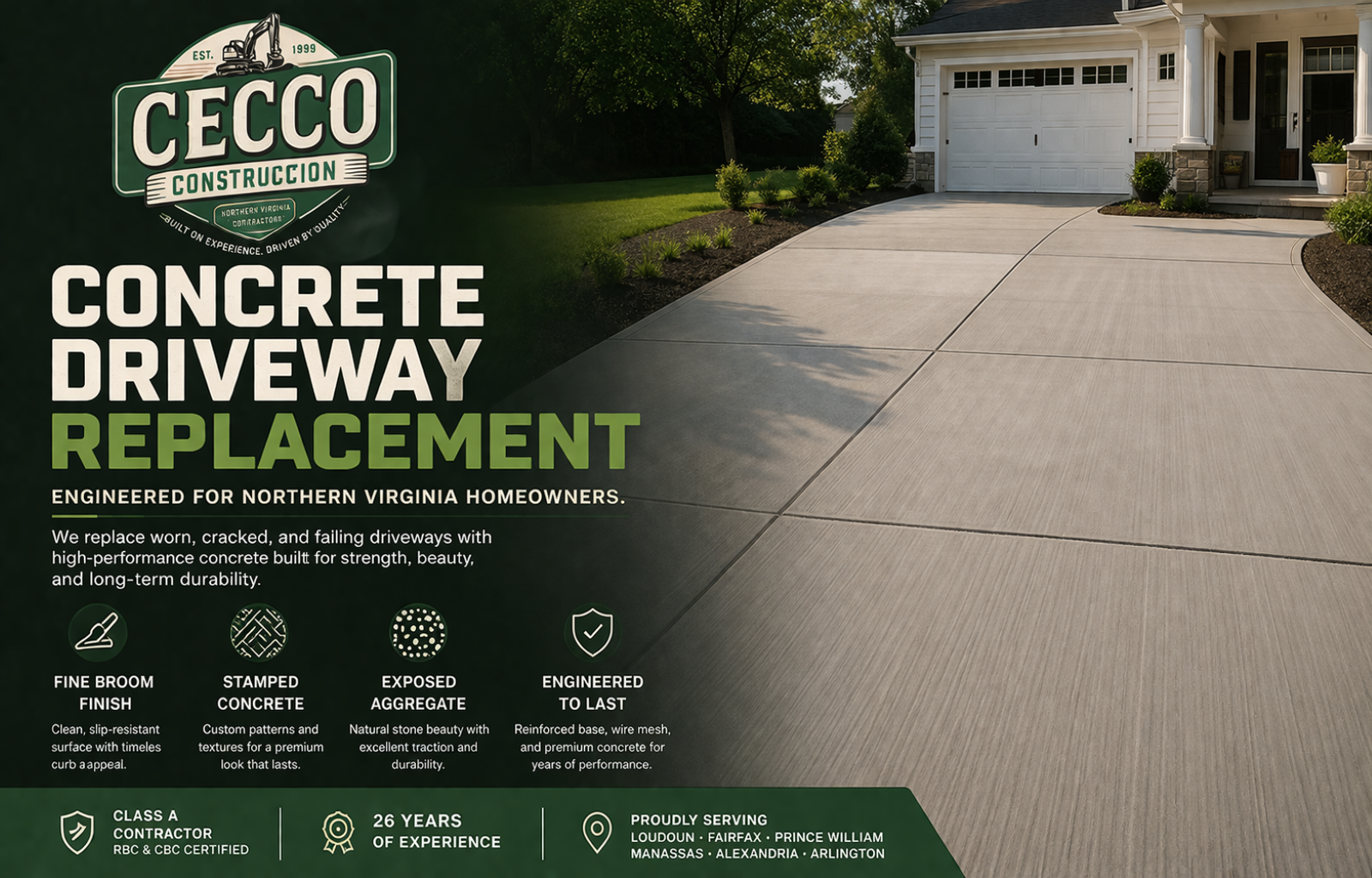
If you are looking for a reliable, long-lasting concrete driveway replacement in Northern Virginia, Cecco Construction is your go-to source. We specialize in engineered driveway solutions and driveway apron installations designed to withstand heavy use, harsh weather conditions, and the test of time. Whether your existing driveway is cracked, sinking, outdated, or failing at the apron connection to the street, Cecco Construction delivers professional results built with precision and durability in mind.
We proudly serve all areas of Northern Virginia, including Loudoun County, Fairfax County, Prince William County, the City of Manassas, the City of Alexandria, and Arlington. Cecco Construction has built a reputation on quality workmanship, engineered solutions, and getting the job done right the first time.
At Cecco Construction, a driveway is more than just a surface — it is a structural system that must be built correctly from the ground up, including the critical driveway apron where your driveway meets the street. We approach every project with an engineering mindset, ensuring that your new driveway and apron are both visually appealing and structurally sound.
Every Cecco Construction project begins with proper subgrade preparation. We remove unsuitable soils, regrade the area, and ensure proper compaction before any materials are installed. This step is critical to prevent future settling, cracking, and drainage issues, especially in high-stress apron areas.
Cecco Construction installs a solid gravel base that provides stability and load distribution across the entire driveway and apron. This base is carefully compacted and leveled to create a strong foundation for the concrete. Reinforcement, including wire mesh, is incorporated to increase strength and reduce cracking over time.
Not every old driveway needs to be completely removed and replaced. If the concrete is still structurally sound but looks worn, stained, scaled, or weathered, driveway resurfacing may be a smarter and more cost-effective solution. This is especially valuable if you are preparing to sell your home and want the driveway to look clean, finished, and professionally restored without spending the money for full replacement. Cecco Construction evaluates the existing concrete, drainage, surface condition, and cracking pattern to determine whether resurfacing is a viable engineered repair option or if full driveway replacement is the better long-term solution.
Reinforcement helps control cracking and improves the structural integrity of the concrete slab. Combined with proper base preparation, Cecco Construction ensures your driveway and apron can handle vehicle loads, curb stress, and seasonal ground movement.
CECCO Construction proudly provides driveway replacement and apron installation services throughout Northern Virginia.
Cecco Construction proudly serves:
Cecco Construction is a Class A licensed contractor with both RBC (Residential Building Contractor) and CBC (Commercial Building Contractor) classifications. This means we have the experience and qualifications to handle both residential driveway projects and more complex installations involving apron work and structural requirements.
At Cecco Construction, we believe in doing the job right the first time. No shortcuts, no guesswork, and no compromises on quality. From excavation to final finish, every step is completed with precision.
When Cecco Construction replaces an existing concrete driveway, we do not treat the project as simply breaking up old concrete and pouring new concrete back in its place. A driveway is a structural exterior slab system. It has to support vehicles, shed water properly, resist freeze-thaw cycles, and tie into the existing grades of the garage, walkway, apron, lawn, and street. That is why our process starts with proper mobilization, controlled demolition, grade evaluation, compaction, forming, reinforcement, concrete placement, finishing, joint layout, and curing protection.
One of the major advantages Cecco Construction brings to a driveway replacement project is that we own and operate much of our own equipment. That matters. Owning our own equipment moves the dial on pricing, scheduling, quality control, and production. We are not depending on a third party for every piece of equipment needed to break concrete, move material, load debris, compact the subgrade, place concrete, or clean up the site. This allows us to stay competitive without cutting corners on the actual driveway.
We are also a large-volume concrete buyer. Through our overall concrete volume, and during high-volume production periods, we may be buying thousands of yards of concrete. That purchasing power gives Cecco Construction access to competitive concrete pricing from ready-mix suppliers. Because we buy concrete at a serious volume, we are often able to offer better value to homeowners while still using a premium driveway mix. Competitive pricing does not come from cheapening the job. It comes from owning equipment, controlling labor, buying material correctly, and knowing how to build driveways efficiently.
For a typical residential concrete driveway, Cecco Construction installs a 4-inch-thick concrete slab using a 4,000 PSI air-entrained concrete mix delivered from a ready-mix plant in a barrel truck. The 4-inch slab thickness is the standard approach for most residential driveway applications where the subgrade is stable, the driveway is used for normal passenger vehicles, and the drainage conditions can be properly controlled. Where conditions require additional strength, heavier use, thicker edges, added reinforcement, or base corrections, we evaluate those conditions before the concrete is placed.
The first step is mobilization. On many standard driveway replacement projects, Cecco Construction mobilizes a 185 CFM compressor package with two 90-pound pneumatic jackhammers. This gives our crew the ability to break up the existing driveway in a controlled manner without relying on undersized tools or slow demolition methods. If the driveway is larger, thicker, reinforced, or requires faster production, we may use a skid steer equipped with a hydraulic jackhammer attachment. The equipment selected depends on the size of the driveway, the thickness of the existing concrete, site access, and the condition of the existing slab.
Because Cecco Construction owns and operates the type of equipment needed for this work, we can mobilize properly for the job instead of showing up under-equipped. That is an important difference. Proper equipment allows the crew to remove the driveway efficiently, control the demolition process, reduce unnecessary labor delays, and keep the project moving. It also helps us remain competitive because we are not building every job around excessive rental costs.
Our demolition process normally starts at the back of the driveway and works forward toward the street. This allows the crew to maintain control of the broken material, keep the work area organized, and move the job forward in a logical sequence. The existing concrete is broken into manageable sections so it can be removed efficiently without damaging the surrounding property.
Once the concrete has been completely broken up, Cecco Construction removes the hammer attachment from the skid steer and switches to a bucket. The broken concrete is then loaded into our own dumpsters and removed from the property. This keeps the site cleaner and allows us to control the debris removal process instead of leaving piles of broken concrete sitting on the homeowner’s property.
After the old concrete has been removed, the driveway area is evaluated. This is an important step. We look at the exposed soil, the existing base, the grade, the garage transition, the apron area, and any areas where water may have been sitting. Any loose or disturbed areas are mechanically tamped and compacted. Compaction is critical because concrete should not be poured over loose, unstable, or poorly supported material.
If gravel or compactable stone is needed, Cecco Construction installs it where the site conditions require it. Not every driveway replacement requires the same amount of stone because not every existing driveway has the same base conditions. Some driveways already have a stable base beneath the old slab. Other driveways have soft areas, settlement, wet soil, clay, or disturbed material that must be corrected. Our approach is to evaluate the subgrade and install compactable material where it is needed to create a more stable support system under the new driveway.
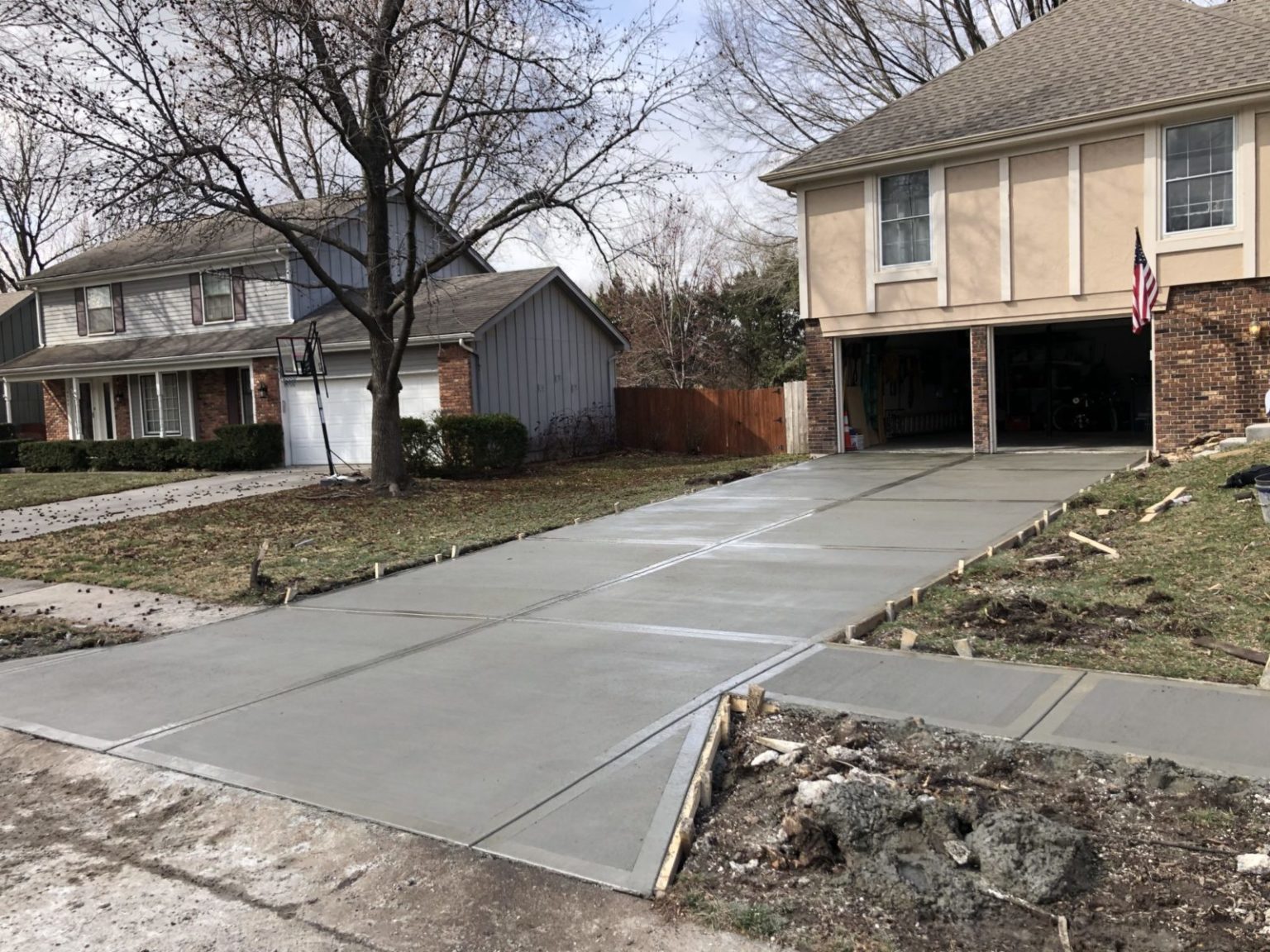
Once demolition, cleanup, base evaluation, and compaction are complete, Cecco Construction moves into layout and forming. This is where the new driveway begins to take shape. We use 2×4 lumber to form the driveway perimeter. These forms establish the edges of the new concrete, the final width, the driveway flare, the connection to the garage, and the transition to the existing apron or street connection.
At this stage, we encourage the homeowner to look carefully at the layout. This is the right time to make changes. If the driveway needs to be widened slightly, if the flare needs to be adjusted, or if the edge alignment needs to be corrected, it is much easier to move wood forms before concrete is poured. Once concrete is placed and finished, changes become difficult, expensive, and unnecessary if the layout is reviewed properly before the pour.
Grading is one of the most important parts of the entire driveway replacement process. A driveway should not be treated as a flat pad. It has to be shaped to move water. Water should not sit on the driveway, run into the garage, collect at the foundation, or create ponding near the house. Proper grade is what makes the driveway function after the concrete has cured.
To control grade, Cecco Construction uses short sections of rebar driven into the ground as grade stakes. These grade stakes establish the finished elevation of the concrete. They give our crew a physical reference point during concrete placement and screeding. When the concrete is being placed, the top of the grade stakes helps confirm that the slab is being installed to the correct elevation and slope.
The goal is simple: move the water where it is supposed to go. If the property already has a natural slope, we work with that slope. If the existing grade is poor, flat, or complicated, we establish the best practical drainage path available. Sometimes that means directing water toward the street. Sometimes it means moving water toward an approved drainage path. Sometimes the grade must be carefully balanced between the garage, the house, the lawn, the apron, and surrounding hardscape.
Once the 2×4 forms are installed, the homeowner has reviewed the layout, the grade stakes are set, the subgrade has been tamped, and reinforcement is in place, Cecco Construction prepares for the concrete pour.
For our typical residential driveway replacement, the finished concrete slab is 4 inches thick. This thickness is appropriate for most residential driveway applications when combined with proper grading, compaction, reinforcement, and a quality concrete mix. The slab thickness must be consistent enough to provide strength across the driveway. Thin spots are a common problem with low-quality driveway work, and thin concrete is more likely to crack, break, settle, or fail under vehicle traffic.
Cecco Construction orders concrete directly from the ready-mix plant. Our driveway design mix is 4,000 PSI air-entrained concrete. Air entrainment is important for exterior concrete in Northern Virginia because driveways are exposed to rain, freezing temperatures, thaw cycles, surface moisture, and winter conditions. A properly designed air-entrained mix helps the concrete perform better in freeze-thaw conditions.
We do not use volumetric trucks for our driveway replacement work. Our driveways are built using concrete delivered from a ready-mix plant in a barrel truck. This gives us a properly batched design mix, consistent material, and the quality control needed for a driveway that is expected to last. A driveway is not the place for guesswork. The concrete mix matters.
Our buying volume also matters. Cecco Construction’s relationship with concrete suppliers is built on serious production, repeat purchasing, and volume. Because we are not buying concrete like a small one-off contractor, we can often secure stronger pricing while still using the proper mix design for the job. That allows us to stay highly competitive without dropping down to weaker concrete, poor placement methods, or shortcuts that hurt the homeowner later.
Depending on the access and site layout, concrete can be placed several different ways. On some driveways, the concrete truck can back directly into the driveway area and discharge concrete as the truck pulls forward. On other projects, access is tighter, so we may use Georgia buggies to transport concrete from the truck to the placement area. In certain situations, Cecco Construction may use a skid steer bucket to place concrete in controlled sections.
Once the concrete is placed, our crew begins screeding. Screeding is the process of striking off the concrete to the correct elevation. A straight board, often a 2×4, is moved in a sawing motion across the forms and grade points. This removes excess concrete, fills low areas, and establishes the surface plane of the driveway. Screeding is not just about making the concrete look flat. It is about setting the slab to the planned grade so the driveway drains and performs correctly.
As we screed the concrete, we use the forms and grade stakes as control points. The crew works the concrete down the driveway, checking that the slab is being placed at the proper elevation. This is where the earlier grading work pays off. If the grade is wrong, the finished driveway will be wrong. That is why Cecco Construction takes grade control seriously before and during the pour.
After screeding, we bring out the bull floats. A bull float is a large finishing tool, often around 42 inches wide, attached to aluminum handles. Cecco Construction uses magnesium bull floats for this stage. The bull float helps flatten the surface, smooth the concrete after screeding, and prepare the slab for the next phase of finishing.
As the concrete begins to tighten up, our finishers continue working the surface by hand. Workers may use knee boards and handheld magnesium floats to refine the surface. Magnesium tools are important at this stage because they allow the concrete to be worked properly without closing the surface too early. Timing matters. Exterior concrete needs to be finished correctly so the surface is not weakened by improper tool use.
Cecco Construction does not rush steel trowels onto fresh exterior concrete. Steel used too early can pull too much cream to the surface, trap bleed water, close the surface too tightly, and contribute to future surface problems. On exterior driveway concrete, the finishing process has to respect the hydration of the concrete. The crew has to know when the concrete is ready for each step.
As the concrete continues to hydrate and set, steel hand trowels may be used only when appropriate for final detailing. Edgers are used along the outside perimeter to create clean edges. Jointers are used where control joints are formed by hand. Every step is done with timing in mind because concrete finishing is not just labor. It is judgment, experience, and timing.
Control joints are one of the most important engineered details in a driveway slab. Concrete will crack. That is a fact. The purpose of control joints is to control where cracking occurs. A properly jointed driveway gives the concrete a planned location to relieve shrinkage stress. Without proper joints, the concrete will create its own cracks, often in random and unattractive locations.
Cecco Construction lays out control joints carefully. On many residential driveways, control joints are commonly placed in the range of 8 to 10 feet in both directions, depending on the driveway width, length, shape, and overall layout. The joint pattern should make sense visually and structurally. A good joint layout should control cracking while also looking clean and intentional.
Control joints may be installed in two ways. In some cases, they are tooled into the concrete while the concrete is still workable, using a jointer and straightedge. In other cases, the joints are saw-cut after the concrete has hardened enough to accept a clean cut. Both methods can work when performed correctly. The important factors are spacing, depth, timing, and layout.
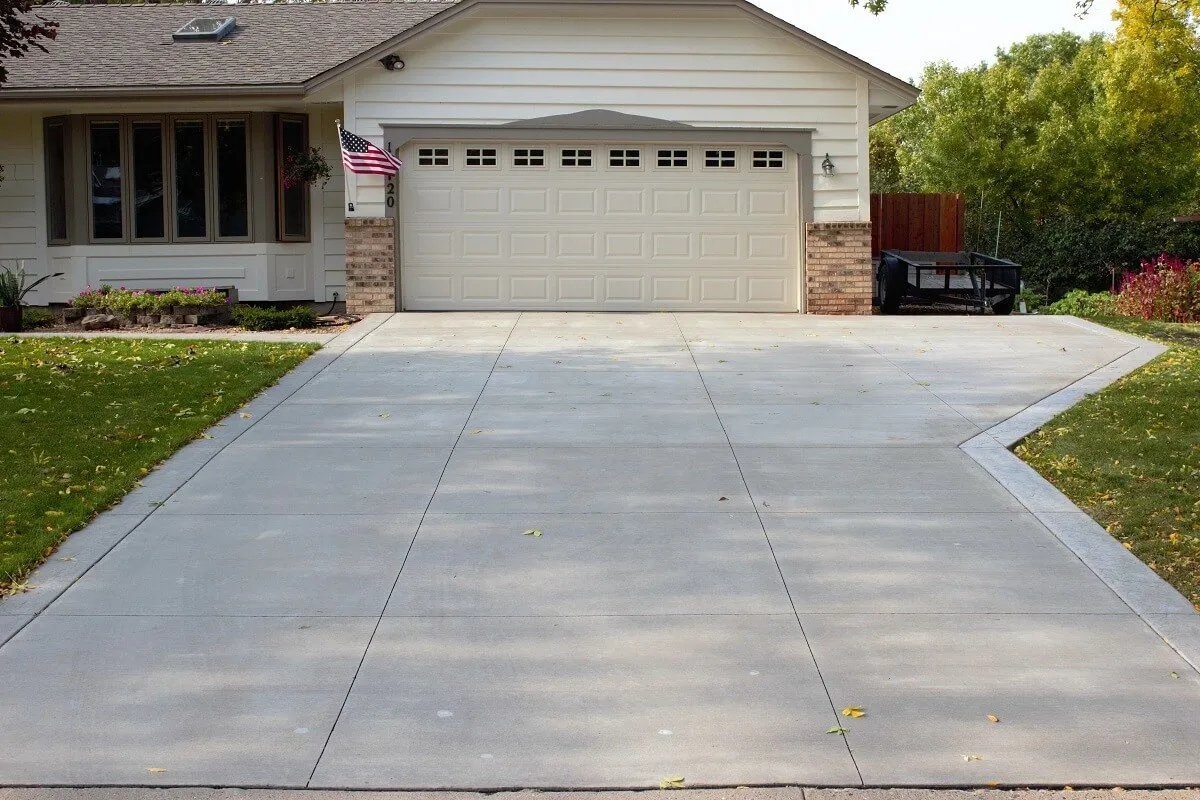
After the edges and control joints are complete, Cecco Construction applies the broom finish. A broom finish is the standard finish for many residential concrete driveways because it provides traction and a clean appearance. But a good broom finish is not automatic. It requires the right timing, the right broom, the right pressure, and a crew that knows how to read the concrete.
If the broom is applied too early, the surface can become too rough, torn, or aggressive. If the broom is applied too late, the broom may barely leave a texture at all. The goal is a fine broom finish that gives traction without making the driveway look sloppy. This is one of the places where experience makes a visible difference.
Cecco Construction uses a concrete finishing broom and clean water during this process. With each pass, the broom is washed off in a bucket of clean water. The broom strokes are kept consistent, usually across the driveway in a clean left-to-right pattern. We do not want heavy overlap marks, dragged paste, damaged edges, or broom lines that run carelessly across joints.
Broom finishing is all about timing. Concrete changes quickly as it hydrates. A few minutes can make a difference. That is why a driveway crew has to stay with the concrete and finish it at the right moment. With over 26 years of field-tested experience, Cecco Construction understands how to work the concrete from placement through final finish.
Once the driveway has been finished, the final step is protection. Cecco Construction installs caution tape to keep vehicles, pedestrians, delivery drivers, and other traffic off the new slab while it cures. A new driveway may look finished on the surface, but the concrete is still gaining strength internally. It needs time to hydrate and cure.
For a typical 4-inch-thick residential driveway installed with 4,000 PSI air-entrained concrete, we generally recommend keeping vehicles off the driveway for about seven days. This allows the concrete to gain enough early strength for normal residential use. Heavy trucks, dumpsters, trailers, or construction equipment should be kept off the driveway longer unless specifically discussed.
Special sealers can be applied for an additional charge if the homeowner wants that added layer of surface protection. Sealing can help protect the surface from moisture penetration, staining, and certain environmental exposure, but the real performance of a driveway comes from how it is built from the ground up.
A long-lasting driveway is not created by one single step. It is created by a complete process: controlled demolition, proper debris removal, subgrade evaluation, mechanical compaction, correct forming, grade control, appropriate reinforcement, a typical 4-inch-thick slab, 4,000 PSI air-entrained concrete, ready-mix barrel truck delivery, correct placement, careful screeding, magnesium floating, proper finishing, clean control joints, a fine broom finish, and adequate curing protection.
Cecco Construction is competitive because we are built for this work. We own equipment. We control production. We buy concrete in volume. We understand scheduling, demolition, forming, placement, finishing, and curing. That combination allows us to deliver a properly built driveway at a competitive price without reducing the quality of the finished product.
That is how Cecco Construction removes and replaces concrete driveways. We build them with an engineered mindset, field-tested methods, volume-buying strength, and a commitment to doing the work right the first time.
Cecco Construction crews show up on time, communicate clearly, and maintain a clean job site. We respect your property and deliver a professional experience from start to finish.
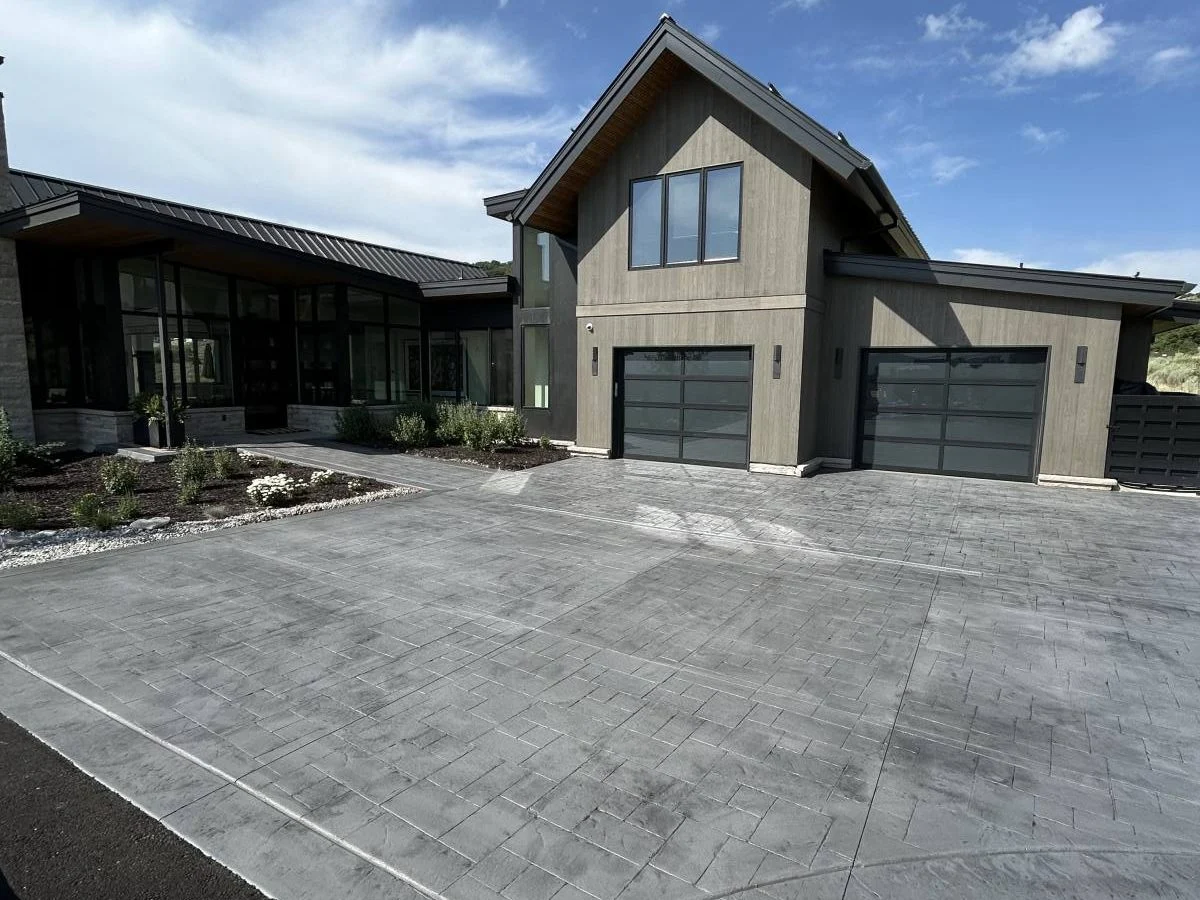
A properly installed driveway and apron by Cecco Construction is an investment in your property. Our use of high-quality materials and engineered construction methods ensures long-term durability and performance.
When it comes to concrete driveway replacement and apron installation in Northern Virginia, Cecco Construction stands above the rest. We combine engineered solutions, high-quality materials, and expert craftsmanship to deliver results you can depend on.
When it comes to concrete driveway replacement and apron installation in Northern Virginia, Cecco Construction stands above the rest. We combine engineered solutions, high-quality materials, and expert craftsmanship to deliver results you can depend on.